

















 lthough these have been researched and cross-referenced with available materials, it is
no substitute for a veterinarian. Many of the largest problems come when raptor handlers wait too long to consult a vet. Birds are highly sensitive and 24 hours can mean the difference between a treatable disease and a dead bird. However, emergencies happen. Falconry is sometimes practiced beyond a geographic ability to get medical assistance. In these cases, doing something may be better than doing nothing.
This is a guide to help identify when to seek help, when to urgently seek assistance, and how to avoid making a mistake in helping your bird. I always carry an avian first aid kit while out hunting or just traveling, and it has a set of printed instructions with it so that I will know how to properly handle an emergency. It also has my veterinarian's business card and other emergency numbers so that he may be contacted for consultation.
Hazards to birds come from all directions. While raptors with falconers are substantially more healthy and long-lived than in the wild, the bird essentially operates as a wild bird when hunting, and these same dangers are in place. Small raptors such as Kestrels, Merlins, and Sharp-Shinned Hawks often are attacked by cats, dogs, or larger raptors in the field - all dangers that a falconer can help mitigate, but cannot prevent. Larger birds are injured by barbed wire, storm fencing, power lines and transformers, cars and traffic, owls and larger raptors, dogs, and coyotes - all dangers that a falconer can help mitigate, but cannot prevent.
It's a good idea to have a helper standing by. It usually takes two people to handle a
big bird that may be fighting or panicked. One can restrain and comfort the bird while the other person takes care of the injury. You and your helper should remain as calm as possible in an emergency situation. The bird will pick
up on your emotions if you are panicked. Make sure nobody's fingers are too close to the bird's beak or talons or injury might result.
lthough these have been researched and cross-referenced with available materials, it is
no substitute for a veterinarian. Many of the largest problems come when raptor handlers wait too long to consult a vet. Birds are highly sensitive and 24 hours can mean the difference between a treatable disease and a dead bird. However, emergencies happen. Falconry is sometimes practiced beyond a geographic ability to get medical assistance. In these cases, doing something may be better than doing nothing.
This is a guide to help identify when to seek help, when to urgently seek assistance, and how to avoid making a mistake in helping your bird. I always carry an avian first aid kit while out hunting or just traveling, and it has a set of printed instructions with it so that I will know how to properly handle an emergency. It also has my veterinarian's business card and other emergency numbers so that he may be contacted for consultation.
Hazards to birds come from all directions. While raptors with falconers are substantially more healthy and long-lived than in the wild, the bird essentially operates as a wild bird when hunting, and these same dangers are in place. Small raptors such as Kestrels, Merlins, and Sharp-Shinned Hawks often are attacked by cats, dogs, or larger raptors in the field - all dangers that a falconer can help mitigate, but cannot prevent. Larger birds are injured by barbed wire, storm fencing, power lines and transformers, cars and traffic, owls and larger raptors, dogs, and coyotes - all dangers that a falconer can help mitigate, but cannot prevent.
It's a good idea to have a helper standing by. It usually takes two people to handle a
big bird that may be fighting or panicked. One can restrain and comfort the bird while the other person takes care of the injury. You and your helper should remain as calm as possible in an emergency situation. The bird will pick
up on your emotions if you are panicked. Make sure nobody's fingers are too close to the bird's beak or talons or injury might result.
Emergency Feeding
Every falconer should have an emergency feeding recipe on hand in case of emergencies. If a bird is sick, has fallen to too low of weight, has been injured, or for any other reason needs nutrition and is unable to get that from standard food, an emergency nutritional recipe should be made up for her.
Mix up equal parts of:
- Meat flavored baby food - or finely chopped meat or pureed meat (richer meat is better, include some fat, but include no bones, fur, or feathers - quail is easily digested by a sick bird; pigeon is very rich but may be too much for a starved bird)
- Karo syrup - this sugar can be digested by the body and absorbed with almost no effort. If you have no Karo on hand, Nutri-Cal can be used as can honey or Coke that has been boiled and cooled to remove carbonation. If the bird is extremely low, cut this back to only a very small amount as excess sugars will cause diarrhea and dehydration.
- Pedialyte - Lactated Ringer's solution is preferred, but not readily available. Gatorade can be used, but is a bit harsher on the bird's system.
- An egg yolk or two - highly nutritious to the bird and readily available.
- Very small pinch of salt - helps retain fluids.
- 0.5 cc liquid vitamins - about 5% of the total amount of food you are making up
With a small syringe (no needle inserted), or eyedropper, you can pump a few CCs into the bird's mouth and let her swallow it.
You can also dip tiny pieces of meat in the mixture and feed that to the bird. Some birds will eat this straight off the plate or your hand.
You can tube this into the crop, but only if you know how to do this, otherwise you can end up passing the tube down the trachea instead of into the crop and end up drowning the bird, or at the very least allowing a tiny amount to enter the lungs and causing pneumonia. If you tube the bird, do not add more food in if a bird has not put over a crop and do not overfill the crop. Keep in mind that a good rule of thumb for raptor stomachs is to estimate about 50 ml for every 1000g of body weight. A 900g bird would have about a 45ml capacity in her stomach, and a 700g bird would have about a 35ml capacity. Over feeding can cause aspiration which can lead to further infection, asphyxiation, or death. It is better to feed small amounts multiple times throughout a day, both for their stomach capacity and for their ability to metabolize. Birds that are strongly resisting may have a tube placed in the wrong place or it may not be delivering the material low enough in the tract.
For a Kestrel sized bird feed her 2-3 CC of this mix every 3-4 hours and keep her warm. If the bird is not kept warm she will stop digesting.
Another solution for an emergency feeding is to get Canned Eukanuba prescription cat/dog food. As it is thick, thin it with water, Pedialyte, lactated Ringer's solution, fresh pigeon blood, or even the water off of washed meat and tube into the bird. Hill's a/d Canned Prescription cat/dog food can also be used, but it has fewer calories.
If feeding pigeon to a sick, but not starved, bird, dip the pigeon tidbits into the above mixture leaving out the slurried meat. Soak the nutritional supplement mixture into the feathers and feed tiny bits of breast meat. Make sure to feed the guts to keep the gut flora going in your bird. Calf liver will also work well for a sick bird.
Nutrical contains a substantial amount of fat and is more difficult to break down, so for starved birds Nutrical should be avoided, and pancreatin should be considered as an additive to help the digestive process. Once the bird is past the starvation, the pancreatin can be omitted and more nutritional additives like Nutrical can be added.
Pedialyte is hypertonic and so will draw fluids into the bird's digestive tract. For severely dehydrated birds Pedialyte should be avoided until the bird is sufficiently hydrated to tolerate it.
Always keep an emaciated bird warm and hydrated. Consider B-complex vitamins and antibiotics if necessary. Also consider proboitics. Including about 1 TB of yogurt or kefir in 100 cc of fluid can help support the raptor's natural flora. Be aware that yogurt and antibiotic should not be fed within 2 hours of each other. Yogurt is particularly useful after any antibiotic to repopulate the gut bacteria.
Avian Emaciation http://www.urbanwildlifesociety.org/WLR/Emaciation.html
Emergency First Aid
In any emergency, remain calm. Gently restrain your bird in a towel to examine it. Remember, it's extremely important to be careful when restraining the bird - don't put a lot of pressure on her chest or she may suffer breathing problems.
| Medicines | Topicals |
| Antacid preparation (TUMS) | Aloe Vera |
| Benadryl Allergy | Antiseptic towelettes or wash |
| Pepto-Bismol | Artificial tears |
| Band-aids | |
| Cornstarch | |
| Neosporin Ointment | |
| Rubbing alcohol and alcohol swabs | |
| Tissue glue | |
| KY Jelly |
| Tools | Dressings | Other |
| Penlight | Cotton balls | Favorite food |
| Nail clippers | Gauze pads | Pedialyte (or generic equivalent) |
| Nail file | Hot/cold pack | Paper towels |
| Needle-nose pliers | Popsicle sticks or tongue depressors | Sterile water |
| Rubber gloves | Q-Tips | Squirt bottle filled with water |
| Scissors | Vet Wrap or Paper Tape | Water and cup |
| Stockinette or sock | ||
| Syringes | ||
| Towel | ||
| Tweezers | ||
| Wire cutters | ||
| Pill cutter and crusher |
National Animal Poison Control Center Hotlines
1-800-548-2423 - $30 per case
Or 1-900-680-0000 - $20 first 5 minutes, plus $2.95 per additional minute
1-800-345-4735
1-800-222-1222 - National (human) Poison Hotline
Vet - Always have your vet's name, number, and address handy. If you're more paranoid and will be on a hunting trip far from home, sighting out potential vets in the location you will be is not a bad idea.
Recommended raptor veterinarian list
Extended Avian Kit - recommendations
Betadine or Hibitane (chlorhexidine) - A disinfectant. Do NOT use hydrogen peroxide since it can cause tissue injury in birds. Clotisol - Blood clotting gel, when applied to a minor wound, feather follicle, bleeding talon or beak, will quickly and safely stop bleeding. It is safer and less caustic than clotting powders or sticks, and may be applied with cotton-tipped applicators. Avoid getting on mucus membranes (eye or lid, mouth or cloaca). Eye dropper Goo Gone - Used to cut through grease or any substance that may be stuck to the bird's skin or feathers. Another option is a chemical called Polysorbate80. This may be available at your pharmacy. Either can be used with a soft toothbrush to spread into feathers and allow to sit for a few moments before rinsing out with warm water. Kaopectate Lactated Ringer's solution - Used for IV rehydrating of dehydrated avians and flushing wounds. Can give subcutaneous Lacated Ringer's solution if a bird is dehydrated or in shock. (Available from your Veterinarian) Latex tubing - To be used as directed by your avian veterinarian, to insert into the crop to administer medication, fluids, hand-feeding formula, to flush out a crop that won't empty, to flush cool water into a crop immediately after a crop burn is discovered. If you are not familiar with these procedures, discuss them with your avian vet before you have an emergency so that you may learn the proper techniques. Neck brace - Gray foam in a circle, to be used to keep a bird from chewing feathers or mutilating flesh, cut to length to prevent a bird from bending neck down to bite skin or feathers, then tape, make sure bird can access food and water with neck brace in place. Ophthalmic ointment - For scratched eyes, minor conjunctivitis. Povidone iodine swab - May be used to clean and treat a wound, as directed by your avian veterinarian. Tegaderm - Excellent for covering certain types of open wounds. Helps healing for burns and certain open wounds. Encourages granulation (healing/scabbing). Sterile lubricant - To be used as directed by your vet to cover an open wound (to keep it moist and prevent infection). Sterile KY Jelly does an excellent job of this and can be tossed into a first aid kit to cover an open fracture site or other open wound until a veterinarian can attend it. Sterile surgical blade - To be used as directed by your avian vet, can cut fibers tied around toes, etc. Suturing materials (surgical needles and thread) - Use only if you know what you are doing, or to save a bird's life. Take to veterinarian ASAP.
Avian First Aid Instructions
Danger Signs and EmergenciesThere are many problems which you should be prepared for. Any time a bird has any of the following symptoms: stops eating, sits fluffed on the floor, is bleeding from mouth or vent, has uncontrollable bleeding, has runny eyes, can't breathe, sneezes with discharge, has diarrhea, has constipation (straining to defecate), has loss of balance, depression, or lethargy, take your bird to the veterinarian. Birds do not have much clotting agent in their blood. A broken blood feather, or a minor cut, can be life threatening. The bleeding must be stopped. If bleeding does not stop, apply pressure and rush the bird to the veterinarian. In Emergencies
Keep an injured bird warm by transporting it on a heating pad, hot water bottle, or make-shift water bottle that is a latex glove filled with hot water. Transport it in a carrier, box, or plastic box covered with a towel, to minimize visual stimuli and make sure the bird is secured and cannot escape. To safely transport your bird to the vet, remember these three things:
- Warmth
- Darkness
- Carrier
Disinfect skin. Poke with sterile needle to allow air to escape. Repeat as necessary. Air sacs are located inside the neck, chest and belly. When ruptured, air will leak from the sac and accumulate under the bird's skin. If air is not released, the tear in the sac will enlarge. If there is no improvement within 48 hours, it will require surgical repair or antibiotic therapy. ANOREXIA
Feed with a syringe only if you know what you are doing. BLEEDING
Avian blood has very little clotting agents in comparison to mammal blood. A bird can literally bleed to death from a broken blood feather. Cleanse the area gently with rubbing alcohol, Nolvasan or Betadine, but not with hydrogen peroxide. Stop any serious bleeding with pressure and a sterile gauze, or use clotting gel. Apply cornstarch, baking soda, or flour to stop the bleeding, but not Quik Stop (silver nitrate) as it causes tissue damage and can cause poisoning. Pack styptic on liberally to the site of the wound. If necessary, cover the wound with gauze pads and hold firm pressure on the wound for two minutes. Keep the bird quiet and warm. Leave the gauze on. Offer Pedialyte. If cut is on leg or feet, apply antibiotic ointment, then bandage loosely. If cuts are on the body, cover with gauze and appropriate size stocking, (cut hole in toe for head and slide over body). Bleeding in avians may be an emergency. It is important to recognize which situations can be managed at home and when veterinary care should be obtained as soon as possible. Don't panic. Stay calm. Concentrate only on stopping the bleeding. Birds can loose up to 10% of their blood volume without becoming symptomatic. When handling a bird to control bleeding, good restraint technique is important to ensure that the bird is not getting overheated. Holding the bird in a damp towel will help reduce the risk of heat stress. Failure of bleeding to stop with appropriate first aid measures may indicate underlying liver disease. Transport the bird as soon as possible to a veterinarian. The bird may require treatment for shock. Have the phone numbers of your avian veterinarian as well as an after-hours veterinarian readily available. For Clotrisol as a styptic: Moisten the applicator and apply firm pressure to the bleeding for several seconds to stop bleeding. Reapply if necessary. Serious bleeding or deep wounds should be cared for by your avian veterinarian only. Until you can get to your vet, use a sterile dressing and apply direct pressure to the bleeding area. If a beak or talon is split, or broken far back, if clotting gel does not stop bleeding, apply ice to the talon or beak, and take the bird immediately to your avian veterinarian.
Bleeding from broken blood feathers
Apply cornstarch or flour to feather shaft and observe. Tissue glue, if available, may be used instead. Take care to avoid getting on surrounding feathers. If this fails to stop bleeding, take bird to veterinarian. Pulling blood feathers should not be done routinely because of risk of damage and prolonged bleeding from follicle, but may be required if feather is cracked or bent badly (bird may chew feather and start bleeding again.)
If veterinary care is not readily available and bleeding is not controlled:
Grasp the bleeding feather shaft firmly at base of feather close to the skin with hemostat or needle-nose pliers, holding wing firmly and pull shaft out quickly. If follicle bleeds apply pressure for 1 minute with thumb and index finger. If pressure fails to control bleeding from the follicle, apply cornstarch or flour. Gelfoam (obtain from avian vet) may be used instead of cornstarch or flour. In RARE situations, you may have to apply tissue glue over the Gelfoam to control the bleeding from a follicle. If a feather is merely broken off but not bleeding, do not pull the feather if at all possible. There's a significant likelihood that it will damage the feather follicle.
Bleeding from talons
Apply cornstarch or flour and apply pressure. Although Quik Stop may be used on the beak or talons, a talon treated with Quik Stop could be used to scratch the face and silver nitrate is not a substance you want in the eyes. For this reason, other substances are safer to use. If nothing else is available, apply PRESSURE until the bleeding stops.
Bleeding from beak
Apply pressure, cornstarch or flour. If available, apply Gelfoam and cover with tissue glue. Bird should be assessed by avian vet to determine extent of damage (most damage is not visible externally). If the tip of the beak has broken off due to trauma, there may be cracks higher up. Stabilization of the beak with an acrylic may be helpful. Beak injuries may be painful. Provide a soft diet until bird can eat normally.
Bleeding from the mouth
Serious emergency usually indicating internal injuries. Large blood losses can occur quickly. Keep bird warm and quiet. Transport to veterinarian as soon as possible.
Bleeding from the vent
Causes include egg-binding, polyp, ulcer. May see bloody diarrhea. Serious emergency. Keep bird warm and quiet. Transport to veterinarian as soon as possible. A bound egg may be loosened by dipping a finger in mineral oil and slipping into the cloaca to coat the cloaca and egg with oil. The egg may release as you withdraw your finger. A bound egg may also be treated by having a vet inject the bird with calcium. A bird that frequently gets bound eggs may need to be treated with Lupron. BROKEN BONES
If there are obvious fractures, wrap the bird in a stocking to prevent the wings from flapping, or apply a splint to keep broken bones from causing more tissue damage. Look for shock symptoms. If bone ends are exposed, gently slather on some KY Jelly (or Neosporin if you have nothing else). KY Jelly is water soluble and easily rinsed off, and may actually save the bone from amputation.
Wings - cut toe out of appropriate size sticking allowing bird room to expand chest while breathing. Place over bird with head through cut hole and cut opening for feet. Support the broken bone and do not attempt to straighten.
Toes - wrap gauze into ball. Put foot around ball. Wrap foot to gauze ball with gauze.
Call the vet and get there as soon as possible BROKEN FEATHERS
A broken feather will most likely require imping. While a bent feather can be dipped in luke-warm or warm water and on removing from the water will start to straighten out, a broken feather is much more involved to fix. BROKEN TALON
Restrain bird, dab area with gauze, apply styptic (corn starch or soap bar are the safest styptic materials). Observe to make sure bleeding has stopped. If there is uncontrolled bleeding for more than a few minutes, call Vet.
If talon is split, or broken far back, if clotting gel does not stop bleeding, apply ice to the talon, and take the bird immediately to your avian veterinarian. A broken talon will grow back eventually. Some recommend covering the talon core with clear nail polish to help protect the core, which is very sensitive. Hawk should be held back from hunting until this heals. BROKEN BEAK
Restrain bird, dab area with gauze, apply styptic (corn starch or soap bar are the safest styptic materials). Observe to make sure bleeding has stopped. If there is uncontrolled bleeding for more than a few minutes, call Vet. A cracked beak may grow back if the "bed" or "quick" area is not damaged. It will need frequent tending as it grows out, such as trimming, filing - will be a long recovery but may be possible. Temporary repairs can be made with dental epoxy and fiberglass reinforcement.
If the beak is cracked, split, or broken far back, if clotting gel does not stop bleeding, apply ice and take the bird immediately to your avian veterinarian.
A great case from rehabilitator Sharron Montgomery of the Falcon Batchelor Bird of Prey Center: I suspect she broke her beak from the constant tugging on the bandages, weakening it slowly over time. She has been without them since the beak breakage and is doing well. [This shows] the progress after 2 months. It was really quite amazing how well she adapted. We only had to cut her food for a couple of weeks after [the after photo was taken]. A broken beak may be treated with dental acrylic or methyl methacrylate (a substance use din repairing the hooves of horses) where more beak material is needed to be added, quick drying epoxy or quick drying superglue where the crack is more superficial, or treated like a ladies' manicure laying silk over the crack and applying a quick drying superglue in order to reinforce the structure.
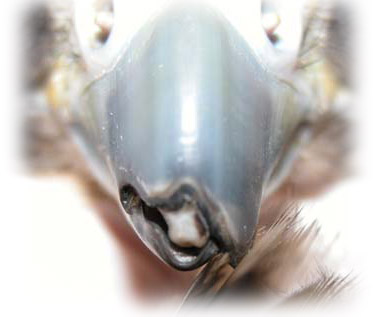
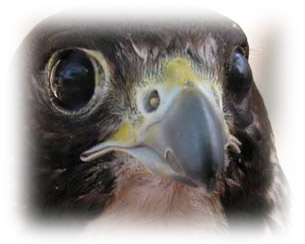
Peregrine with a broken beak (image on left) and same Peregrine after two months (picture on right)
Photo courtesy of Sharron Montgomery of the Falcon Batchelor Bird of Prey Center
Video about an eagle with a broken beak BURNS
Many creams and lotions are toxic to birds, so make sure that you use 100% pure Aloe Vera or something known to be safe like Silvadene or Bactroban.
Spray or flush with cool water. Glaze burns twice daily with small amounts of antibiotic ointment.
BURN BY ACID: apply a thin coat of baking soda paste.
BURN BY BASE (like bleach): treat with vinegar to neutralize.
BURN BY GREASE: sprinkle with flour or cornstarch before rinsing with water. Be careful not to get any in eyes or nose. BITES
Wash out with alcohol. If it is not deep, apply antibiotic ointment. Vet can administer injectable ampicillin. Clavamox is particularly good for skin wounds.
Cats transmit a bacterium called pasteurella with their bites or scratches. In birds, this causes Pasteurella septicemia, which can mean death within 24 hours if not treated. CHOKING
Sometimes birds' eyes are bigger than their crops or a small bone catches in the throat. If the bird is able to get air, allow her to try to work it down. If bird is not able to get air through, grab bird and tip her upside down with a short jolt to attempt to dislodge the blockage. If you can reach inside the beak and grab the food out, do so carefully. This is an urgent and very serious problem and even wild birds have suffered from this. This can be prevented for the most part by carefully cutting up the bird's food preventing such parts as ribs sticking out from vertebrae from catching in the throat. COLLISION
Birds frequently collide with other objects such as a rock, tree, window, or car. Collisions are typically head on, and so head trauma must be considered. Collisions may also involve the keel. Birds are often knocked unconscious in a collision. They should be carefully picked up making sure not to move their position too much in case there is a fracture. Transporting a bird on a towel will help support her. Immediate concern is head trauma and veterinarians will treat with Metacam (meloxicam). CONVULSIONS
Place in a quiet, padded box. Can be caused by poisoning, nutritional deficiency, epilepsy, or infectious disease (bacterial, fungal, viral, or parasitic). If this is apoplexy, give bird Pedialyte, Gatorade, or a sugar-salt water solution to replace electrolytes. CROP BURNS
If you realize in time, flush the crop with cold water. If crop appears swollen and discolored (many days after) apply vitamin A and D ointment and feed small meals. CROP EMPTYING PROBLEMS
A few drops of Maalox or Digel, or a few drops of mineral oil (orally) and massage crop. CROP TEAR
You will notice a drop of blood on the bird's feathers in some cases. Other times a bite of food will literally fall out of the bird's crop and onto the ground. Suturing is very difficult with this thin skin, however some tears are cleaned up and treated with tissue glue. Many times a small tear will just heal on its own given rest and small meals.
Feed the bird small quantities of food at a time to prevent future tearing. A course of antibiotics should be given. DIARRHEA
Feed a few drops of Pepto Bismol. EGG BINDING
Put bird in steamy room (like bathroom with shower on) 85°-90° Fahrenheit, humidity 60%. Set bird on wet toweling. Give high calorie, high calcium food. Can also try coating finger in clean vegetable oil or mineral oil and reaching into the cloaca until your fingertip touches the egg. Rolling your oiled finger around against the egg and slowly pulling your finger out sometimes lubricates the cloaca and egg sufficiently and pulls the egg out as you withdraw your finger. ELECTROCUTION
Keep bird confined and warm. Avoid giving any fluids. Immediately seek veterinary assistance for diuretics (Lasix (furosemide) or Azium (dexamethasone) dosed appropriately for raptors). EYE PROBLEMS
Keep bird away from intense light. Flush eye with clean water using cotton ball or syringe.
OBJECT IN EYE: float it out with KY Jelly or Ophthalmic ointment. Do not try to remove it mechanically as it could scratch the eye. FOOD FOR SICK BIRDS
Mix one pint of water, one pint of Gatorade, 1 teaspoon of honey or Karo syrup, 1 level teaspoon of baking soda, 1 level teaspoon table salt. Caution: Measure with care; inaccurate measurements can cause severe diarrhea. HEATSTROKE
Spray feathers with cool water. Put feet in cool water. Place in cool, dark room. Watch bird for shock. Wrap loosely in towel to prevent chill. HYDRATION FOR SICK BIRDS
Pedialyte, Gatorade, orange or cherry juice offered orally. Gavage (tube) only if you know what you are doing. Lactated Ringers subcutaneous if you know how to administer. OIL CONTAMINATION OF FEATHERS
Dust bird with cornstarch or flour (keep away from eyes and nose). An easy way to do this is to fill a pillowcase with flour, cut a hole for the head, stick it through, gently shake it. Then fill sink with 3 or 4 inches of warm water and mild detergent (like Dawn) or Goo Gone. Work soap in directions of feather growth and rinse (sink spray attachment is helpful). Dry and keep bird warm. Wait until next day to repeat (if necessary). This works for cleaning tar, oil, mutes and nearly anything that is caked on the feathers weighing down a bird, preventing normal movement, and preventing her from regulating her temperature properly. While OxyClean can be used on moulted feathers to clean them or on the tips of feathers, I have not heard of anyone using it on a raptor's body directly and it may cause damage to their sensitive skin. POISON
Call vet and follow directions. If vet is not accessible:
If by acid, alkalis, or petroleum product: make it swallow milk, mixed with Pepto Bismol or Kaopectate (1cc/100 grams body weight), eggwhite, or olive oil. DO NOT MAKE BIRD VOMIT!
If by other: induce vomiting. Use mustard and water solution and put at the back of the throat. If known, call poison control center: 1-800-548-2423 - $30 per case
Or 1-900-680-0000 - $20 first 5 minutes, plus $2.95 per additional minute
Note: mushrooms, crayons, some fruit pits, nicotine, chocolate, and foil may be bird poisons. PUNCTURES
This depends on what the source of the puncture is. In general, cleaning it with an antibiotic soap, treating it immediately with Nolvasan or Neosporin and getting her to a vet as soon as possible is the best course of action. Punctures can go deeper than you think, can have extensive internal damage, and can heal from the outside in, all of which are problematic to her health. Many punctures will become infected, and if Pasteurella septicemia is developed, this can mean death in as little as 24 hours.
SHOCK
Symptoms are fluffed feathers, not moving, rapid shallow breathing, head may be turned with eyes partly closed.
Place bird in warm (86°-90° F), secluded, dimly lit environment. If accompanied by life threatening injuries, treat injuries immediately. If head trauma is suspected, it may be better to keep the bird cooler to prevent brain damage. SICK BIRD
Place in small darkened enclosure, keep warm. Offer favorite foods and Pedialyte or Gatorade. Call vet. SPRANG WING
Keep the bird in a dark, stress-free area to allow her to rest. STINGS
Bee stings are not uncommon as yellow jackets are attracted to the smell of meat. The largest danger is a sting in the throat as the bird could have trouble breathing. Keep the bird away from bees, and if she is stung externally, a paste of baking soda and water will help draw the venom out. SWALLOWING STRANGE OBJECTS (Foreign body ingestion)
Observe bird and keep them quiet. Try to locate object to see if in fact they swallowed it. Palpate crop area carefully. Call Vet for advice VOMITING
Treat with a few drops of Pepto Bismol.
Links
- Raptor radiographs http://www.nahnyc.com/radiology.htm
- Wound Assessment in Avian Wildlife http://www.worldwidewounds.com/2003/august/Cousquer/Avian-Wound-Assessment.html
- Wound management in the avian wildlife casualty - Part 1 http://www.worldwidewounds.com/2003/november/Cousquer/Avian-Wound-Management-Part-2.html
- Wound management in the avian wildlife casualty - Part 2 http://www.worldwidewounds.com/2003/november/Cousquer/Avian-Wound-Management-Part-2.html