

















 here are many shapes and sizes of mews. There really are few constraints except the legal ones, your own living situation, and the bird's needs. Many mews designs appear to us as very unattractive, but are actually much more sensitive to the bird's needs. While we would design a mews for ourselves that had many open windows, many birds become nervous when they cannot hide. Dark corners which, to us, look spooky, become preferred perching places.
Providing materials such as a translucent roof brings light in and barred windows which, from some angles, appear to be solid are excellent features. The flip side to the concern there is that it lets in too much heat in some climates and will overheat the bird.
There are generally two well-defined entities - a weathering yard and a mews. A weathering yard is an open area where the bird may safely spend her days during good weather. A mews is where she will live and is traditionally a stand-alone building completely enclosed. However, there are many structures that are hybrids or are only one or the other, and many situations where birds are kept in other ways.
Birds are generally kept in one of two ways - they are either tethered to a perch and dependent on the falconer moving them and providing for their needs, or they are freelofted loose in an enclosure.
If you have not yet planned your mews, try to visit several local falconers to get ideas of what works in your area or what has worked for them. They will have definite opinions on what worked for them and what didn't and how they would improve their current setup.
 verall Design
The overall design of the facilities to keep the bird must take both the bird and the falconer into consideration. A falconer with hundreds of acres of relatively flat land without restrictions from zoning boards may decide to build very large flight cages for each bird. A falconer in a suburban environment may have a very small mews to meet the legal requirements and keep the bird in the house or garage weathering her in the yard every day. A falconer with a Kestrel can keep her in fine condition in a 3' x 3' x 3' box with shelf perches and barring on two sides. This sort of mews can be kept on a table in the house, in the garage, or outside, even. A falconer with a Red-Tailed Hawk might want a mews that is 8' x 10' x 8' wanting to freeloft her, and will be able to keep her in perfect feather. There are a million ways to keep a bird healthy and in great condition, and more than a million ways she will find to damage a feather or injure herself. Good falconers will look for many options, try something out, and observe how it works for him ready to make changes as necessary.
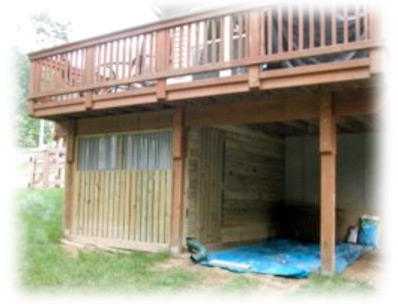 |
This mews takes advantage of unused space in the yard and yet is very attractive. There is enough space between the slats for air exchange, yet the bird cannot see out very well and will be comfortable in the mews. The windows are properly slatted allowing in a good amount of light, but without making the bird uneasy.
Mews by Bob Beagan, photo courtesy of Bob Beagan. |
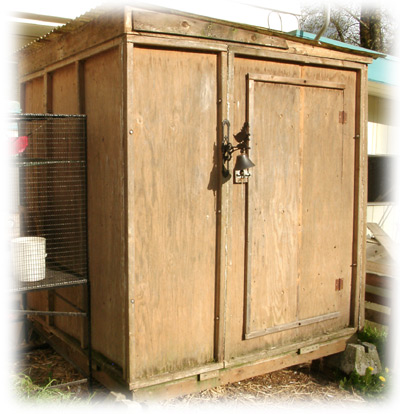 |
This retired mews was built by a falconer who had no access to land and only the basement of his condominium. The mews took up most of the basement and the bird spent her days in a weathering yard. A creative solution to a set of constraints. |
The first consideration is the bird's safety. A mews must be completely enclosed not just to keep the bird in, and preferably in the most private area available. It must be enclosed to keep other animals out. Neighborhood dogs, coyotes, eagles, and other animals will all take advantage of a bird. Even cats can inflict enough damage to a large bird to mortally wound it. The first concern is the bird's safety. If you are making a weathering yard where the bird will spend the vast majority of her time unwatched, then it must be completely enclosed either with wire or a roof structure. For a small falcon like a Kestrel, a dog exercise pen is portable and allows the bird to be safe from most potential harm while being low impact on the falconer. For larger birds a larger structure will be needed.
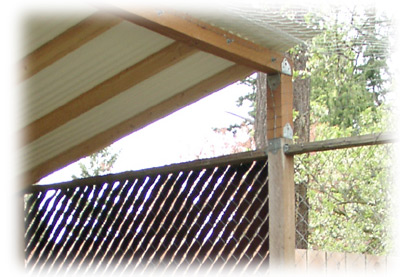 |
This ceiling to a hybrid mews-weathering yard is made of reticulated plastic panels over the mews section and enclosed over the rest with field fencing. Notice that every piece of the mews is protected from an animal attempting to get in. In a fully enclosed mews, clear plastic panels may trap too much heat creating a greenhouse effect and making it unhealthy for the bird. This depends on the setup, the climate, and the management techniques, though. |
One very common aspect to a mews is a two-door entry system. This is more typical with a free-lofted bird where there is the potential for a bird to fly out if the door is mishandled. Having a two door system reduces the likelihood of this from happening. Many falconers who use the two door system take advantage of the space between the doors to make a storage room or otherwise use the space well. If there is no way to implement a two door system, consider using a heavy canvas or duck cloth drape to act as a second door. Even a clear shower curtain will allow you to view the bird as you enter, but make sure she is not able to get past you or attack you. Some falconers have both a two door system as well as a door drape. A note to make the inner mews door open into the mews and not into the preparation area. The reason for this is, again, to help control the bird's ability to get past the falconer or attack him.
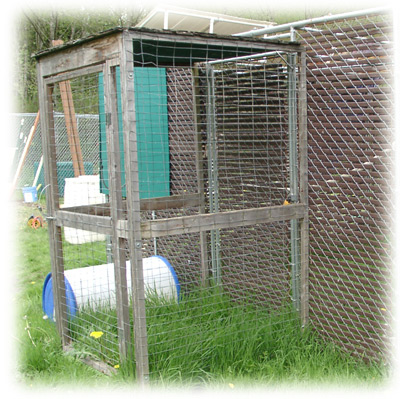 |
This is a simple solution to the two-door issue, yet very effective. The second door is just an extension onto the hybrid mews-weathering yard. |
Modern falconry has many different tradeoffs that traditional falconry never had. Here a falconer has a great setup to allow his birds to weather, even though he is in a suburban neighborhood with limited land.
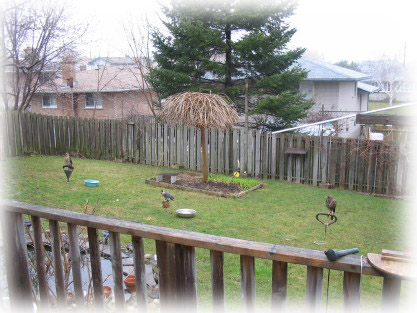 |
A suburban falconry setup for weathering birds
Image courtesy of Dion Thomson. |
Birds of different ages and conditions have different needs. A bird that has injured a foot is often recommended by veterinarians to have all her equipment removed and placed into a large dog carrier in a dark room with a few inches of fresh hay lining the bottom of the carrier. This allows the bird to nest and take weight off the foot temporarily. Immature birds may need to be kept in very different structures and with different methods. Many falconers keeping an immature bird allow the bird free movement within the house while she is growing.
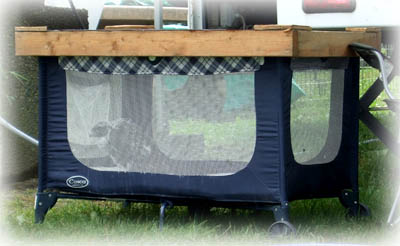 |
Here an immature Gyrfalcon is kept in a playpen with a mesh top to prevent her from getting out, and keeping anything else from getting in. The playpen can be moved inside or outside and the bird can be observed. |
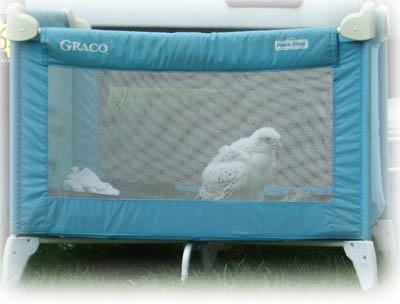 |
Another immature Gyrfalcon in a playpen. |
 ews Flooring
As with anything, a flooring is only as good as your maintenance of it. There is no perfect floor, but some substrates will fit your situation and constraints better than others. Keep it clean and regularly clean out bones, castings, food particles, and mutes. Keep it dry and well ventilated to prevent mold or insects from developing. In general, avoid concrete and brick unless they are overlaid with something else such as padded Astroturf or plywood. Consider how the flooring itself will decay, particularly when damp or with mutes sitting on it. Consider how the hawk food will sit on it, sand will stick to food, and food may sit and rot on a plywood floor depending on the techniques and environment. Consider the ability to sanitize in case of disease. Consider if it attracts or allows insects and other vermin to hide. Consider how it dries after being cleaned. Consider if larger predators can get under, either by digging or by coming through a wall. Lining the ground with a foot or so of chicken wire or hardware wire will help prevent animals from digging under a mews. Extending this out from the mews wall will also help prevent invasion.
Wood chips
Wood chips can make an excellent flooring material if they are used in a way where they are not breaking down. Wood chips don't overheat in direct sunlight. Wood chips also will not dull talons if a bird bates a lot. However, wood chips are a biodegradable material and, when decomposing, they will harbor mold, fungus, and bacteria. In circumstances where they are not getting wet, and are rotated out appropriately, they can be an excellent material.
Pea Gravel
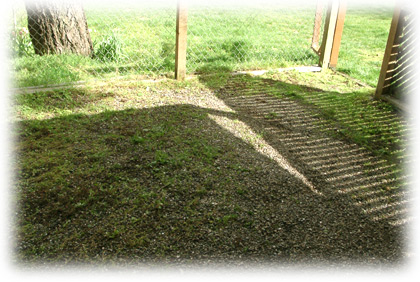 |
This mews floor is pea gravel and works well in this climate. Notice the shading that the slats for the walls provide. This is important in giving the bird enough sun to be healthy, but not so much that she is overheated. |
Pea gravel (sometimes referred to as river bed gravel) should be 1/4" to 1/2" and smooth - not the jagged driveway gravel (crushed gravel).
Sand
Sand can be readily available and work for many falconers. It is easily cleaned out and raked and is easy to manage. However, it will reflect a considerable amount of heat on a bird. A bird who is tethered and bates will have the effect of filing her talons into razor sharp needles. Some falconers spread an inch or two of sand over just a small area of the mews to have the bird bate on that area. However, sand can get under anklets and can abrade the skin. If a bird is fed on sand the particles can be ingested and impact in the GI tract. Sand works particularly well directly underneath a falcon's perch since she mutes straight down. This allows the area to be picked clean regularly.
Dirt or Grass
Dirt or grass floorings may be the easiest flooring to care for and manage. This is a natural environment for the bird and tends to produce healthy feet, although a tethered bird who bates will dull her talons. Dirt can be raked or removed, absorbs well, and contains microbes which help break down both leftover food particles as well as mutes.
Soil types that are more clay-like will tend to dull the talons while soil types that consist mostly of sand will tend to sharpen the talons. Birds who like to walk on the ground or who pace may have the result of sharper talons, or of dulling their talons. Falconers see different results here for different birds and surfaces. Watch how things go for you in this setup and adjust accordingly.
Rubber Mats
Rubber mats can be anything from those found at home improvement stores, to horse and cattle mats, to rubber tracts laid down as a flooring. Mats are easily pressure washed clean. Black mats will heat up considerably and so the temperature must be considered as well as the amount of direct sunlight. Since the surface is impermeable, mutes will dry slowly and tend to smell more than a flooring which absorbs and dries faster.
Astroturf
Similar to rubber mats are Astroturf. There are many different types of materials referred to as "Astroturf" but there is only one true Astroturf. If you want to use this, go to a local driving range and ask them if they will sell old driving range mats. These are padded and have stadium Astroturf adhered to one side. These make excellent padded surfaces and protect the bird's feet in a number of ways. Similar to this is the nesting box pad mat for a chicken coop or what might also be called a hen house poultry nest liner. These can be used similar to the astroturf mats.
Avoid the "daisy" mat of Astroturf - the type that door mats are made of. The "grass blades" are hard plastic with sharp edges and in cold weather they become brittle and break into even sharper edges. This cannot be healthy to the bottom of a raptor's feet.
Shavings
Shavings may work well enough for a flooring in cold climates, but should be cautioned in warm or moist climates. Being fine, they will produce an amount of particulate matter in the air, moisture gets held in them and they can mold (although not as badly as sawdust), but perhaps more importantly, they are small enough for a bird to ingest them, especially if food is dropped onto the floor. Shavings in the system will cause an impaction and can be difficult to diagnose and put over.
Sawdust
Sawdust is too fine for a mews flooring. It holds moisture, molds, and can be thrown into the air and inhaled by the bird. Avoid sawdust.
Straw
Straw, different from hay, is the perfect substrate for mold spores. It likely has some mold already in it from the moisture and spores from harvest, then it has been bundled up and the mold has been allowed to grow. Being an organic material it should be avoided at all costs. Straw even near the mews should be cautioned as the propensity for developing asper is very high.
ews Perches
Perches inside the mews must be provided with the bird in mind. A variety of perching surfaces should also be provided. Perches and windows go together as poorly placed perches in relation to the windows will cause the bird additional stress. Some birds will want to look out, while others will want a perch where they can feel secure and hidden. In a free lofted situation with part of the mews exposed to the weather, placing a favored perch in the weather will help her be exposed to enough sun, rain, etc. Be careful of perches in mews so that they are spaced far enough from the walls that if the bird turns around, her tail will not rub. And a tip to position the bath away from perches to avoid mutes in the bath. Some falconers will even place a large rock, like a large sandstone rock or even a large chunk of salt in desert climates, on a shelf perch or on the floor as another option for the bird to perch and feak on. Placing a window perch about 18" from the window gives her a way to look out of she wants, but keeps her far enough away from the wall that she will likely not damage her feathers. More details on perches.
 |
This mews is set up for birds who are flown every day and hearkens back to the very traditional mews. The screen perch accommodates several falcons at the same time who are then taken out every morning and replaced every evening. |
ews Windows
Mews should have windows, primarily for ventilation. As humans, we would design windows for our comfort with large expanses of open view, however the bird's needs are slightly different. First, the windows need bars to prevent the bird from getting out and other animals from getting in. Most birds want to be able to escape and to hide. Mews windows can help her achieve the feeling of hiding by having slats that appear to be solid wall from certain angles. The ventilation will help air exchange, keep the mews fresh, prevent mold from taking hold, and allow moisture and mute to dry quickly.
Consider which direction the window will face. A southwardly facing window will bring in much direct sunlight and allow the bird to bask, however if that is the direction of winds or rain, then shutters may be appropriate or a mews which faces another direction, or vents placed in particular areas around the mews to allow the proper amount of cross ventilation. some birds are ok with large windows (24"x24") others need smaller windows to prevent bating. Larger windows may make a weathering yard completely unnecessary. Some falconers put an open strip all along the bottom of the mews to allow air exchange and the bird to view the outside if she wishes, but to increase her sense that she can "get up" and hide in the corners. Some birds prefer perches in front of the window, others do not. Consider amount of light to be let in, angle of sun, and wind direction.
For mews bars, thick walled PVC pipe will hold almost any bird in and will not rot although it may be come brittle in cold weather or as it ages. However even the thick walled pipe will flex beyond what some falconers are comfortable with. Some run EMC inside the PVC pipe. This metal pipe inside the plastic pipe means that the PVC cannot be bent to a point of breaking and yet the plastic protects the bird if she does try to fly into the window. PVC is susceptible to breakdown due to UV light, heat, and is more brittle in the cold, but the thick walled exterior PVC will last a lot longer and will be more sturdy. If you will be using wood slats, anything from a 1"x2" to a 1"x6" will work. Mews bars for a Red-Tail sized bird should have no more than 1.75" of open space between the bars. Ideally there would be only 1.5" of open space between the bars. For a mews to hold any bird from a kestrel on up, it should have no more than 3/4" of open space between the bars. An additional advantage is that from an angle the bars block the visual allowing the bird not to see some things that may alarm her, and keeping her more private and unbothered by onlookers.
Also consider screening your window (placing the screen on the outside of the bars) to prevent mosquitoes and bees from entering the mews. This will reduce the likelihood of West Nile Virus and reduce the probability of a bee stinging your bird. If you plan on feeding meat in the mews, consider the early spring when wasps and yellowjackets are searching for meats and attracted to this. Either a fully enclosed mews or a change in the feeding pattern can prevent attracting a nest to be built next to your mews, and help reduce the chance that your bird is stung. Creating window insets allows a window to be fully blocked if necessary in case of storm or need for greater privacy such as breeding.
For a management setup with the bird in the house, some birds are fine without any modification to the home. Blinds or curtains will discourage a bird from trying to fly through a window, and electrical tape can be used to create "bars" on the window and discourage a bird from colliding into it.
ews Cleaning
Cleaning the mews is not necessarily a frequent occurrence, but a clean mews is important. The bathpan should be cleaned and changed regularly in order for the raptor to drink and bathe properly in it. During the summer this may be daily, during the spring or fall this may be weekly, or there may be no bathpan in the mews during the winter. Some falconers are so concerned by the regulations regarding feathers, or by a non-game bird that has gotten into the mews and been eaten, that they will vacuum the mews with a ShopVac clearing out all castings, feathers, or fur, and then even throwing away the ShopVac filter so that no feather particles clinging there can be said to "be in their possession" thereby ensuring they are completely legal with the feather regulations.
If you will be cleaning the mews, first remove all birds from anywhere near the mews. Put the bird in her hawk box or a safe weathering area for the next day or so until the air has exchanged several times, all surfaces are dry, and all cleaning products have dissipated. Use a cleaning product that is safe for raptors. Bleach mixed with water into a 10% solution is fine, or you can visit a farm supply store and find a cleaning product safe for dairy cows. A power washer makes quick work of getting mutes off of gravel, Astroturf, or walls, but be very careful that the bird is not replaced into the mews for several days as the action of power washing aerates all the dirt and mutes and disperses them into the air.
If you are in a climate that is moist and warm and Asper is a large concern you may want to periodically fog your mews with an anti-fungal treatment. This is especially useful when introducing or caring for a Gyrfalcon or Snowy Owl who are prone to Asper.
Some falconers line the inside of their mews with Chloroplast or a shower curtain or use shower stall walls, or line areas where mutes will be flung. This can be attached to the walls with pan head screws and is easy to spray or wash with a pressure washer. Walls can also be sprayed with Simple Green and then scrubbed or rinsed off. If the seams need to be sealed, a tiny bit of silicone can be used. Mews can also be cleaned with plain bleach and water per directions. Particularly difficult mutes can be scrubbed off with Oxyclean. Mews can be disinfected with Symphonel 3 which continues acting for a week after it is applied (birds should not be allowed into the enclosure until it is fully dry). One squirt of this will dilute into a fallow of water for effective disinfecting. Virkon or bleach are also a good disinfectant, however it needs to be fully rinsed before allowing a bird into the enclosure. For general cleaning simple white vinegar is useful and can be diluted 1/4 cup to a liter of water. There are bird mute enzymes that can be sprayed to help break down biological materials. Check a good farm supply store for cleaners and disinfectants for poultry farms. For any cleaning solution I am overall very cautious preferring to clean in warm, if not hot, weather. In this way I have the temperature helping to evaporate and break down the chemicals, and strong direct sunlight helping to evaporate and break down the chemicals. I like to let this works for a few days, if possible, to ensure that the chemicals will not adversely affect the bird. Be sure to read all instructions, and check if birds have any adverse reactions to the chemicals. I also will wear a simple respirator or mask as the dried particles and the chemicals can be damaging to be inhaled.
Consider the drainage and moisture level in the mews. Some falconers install PVC for drainage only to have it clog several years later. You will have a bird's mutes collecting somewhere, how will these get broken down? Do you plan on using water to hose them off? How will that water drain? A pressure washer can get many surfaces clean, but leaves everything soaked and can splash and aerize droplets that the bird, or you, will inhale. Rubber mats or driving range mats over pea gravel will leave enough space for worms, spiders, centipedes, and more, and in some climates mold, mildew, and asper can be a problem. This may be fine in your climate, or it may present problems. Indoor/outdoor carpet is usually not as easy as mats.
 inishing Touches
There are some nice features that any mews should consider.
| Mews can change throughout the year. This mews has shade cloth applied for the summer months to lower the temperature and shade the bird from too much direct sun. The shade cloth is taken down for the rest of the year as the temperate Northwest climate is comfortable for the bird. In more extreme climates, some falconers have installed a misting system such as this one to control the temperature. | 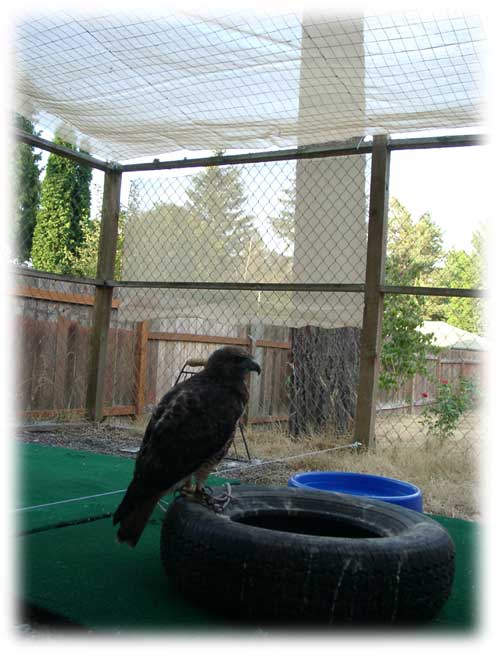 |
Peephole Consider a peephole on a solid side of the mews and on the inner door so that you can view the bird and observe her without affecting her behavior. With a peephole on the door you can enter a freelofted bird's mews more safely.
Paperwork Keeping a copy of the necessary paperwork displayed in the mews can prevent many problems and help law enforcement quickly see that you are perfectly legal. Including your veterinarian's business card and the business card of your lawyer is also not a bad idea.
Thermometer A thermometer is useful when making notes in your log book, but also for monitoring the bird's environment, and the remote thermometers are a great fixture to have. Some mews have a small electric heater placed in it, or a large lightbulb to produce heat, as would be found in a chicken coop.
Food Chute Many falconers include a food chute so that another falconer can feed in case of an emergency or so that they can feed during the moult. With the new temporary care regulations an unlicensed neighbor or friend can even take care of the bird in your mews, and this may help them care for the bird without the need for any ands-on abilities.
Perches and surfaces Having a variety of perching surfaces in a variety of diameters will help keep your bird's feet in good shape.
Toys Some birds like to play. An empty two-liter bottle, dog toy, or sticks can amuse some birds for hours. Other birds haven't the slightest interest in these objects. Great Horned Owls are noted as loving to rip things up, and will tear up heads of lettuce, broccoli, or a white t-shirt for fun. If the bird is particularly into shredding, rope perches may only get destroyed in her mews. A rotten log or stump can have food hidden in it, and many Red-Tailed Hawks enjoy ripping that up to get their meal out. Some birds like to grab and hold something like a stuffed dog toy or a wool sock. Some other environmental enrichments that falconers and rehabilitators found useful include: Beanie Babies, rubber dog toys, Kong dog toys, dog rope toys, stuffed dog toys, parrot toys, tennis balls, phone books to shred, paper bags filled with leaves and tidbits, Holee Rollers (open-lattice rubber ball dog toys)and the like. Variations in the food can be stimulating. Kestrels enjoy chasing down grasshoppers. Chicken and pigeon wings can be picked at for a while as tirings. Vegetables like zucchini, pumpkins, and cabbage are fun for some birds to shred.
Electricity This may seem unnecessary until you want to have a radio, a refrigerator or freezer, and lights (especially during the early dusk of winter). But one consideration for electricity is for helping the moult with special lights, cameras, or heating amenities for a bird during a winter. Some falconers put their lights on a timer so they can go out, feed the birds and leave the lights on for 30 minutes to allow them to eat, then the lights will automatically turn off. Some have GFCI outlets in each bird's mews for plugging in Damp Chasers, heaters to prevent a bathpan from freezing, or other equipment.
Lights While not all mews need lights due to their design, many do have them. When lights are able to be used, consider using a full spectrum UV bulb to help the bird get the amount of UV light appropriate for her.
Video camera Many falconers now have video cameras installed in the mews and around the property to identify any predators or human disturbances. Many have been surprised to find large predators, other raptors, or enforcement agents who have visited their mews when they were not around and found a video camera to be useful in documenting all the events at a mews. It is also useful in monitoring how a bird is doing, especially in low light situations.
Whichever methods and equipment are used, they must work for the falconer, the bird, the environment, and the overall training methods. Two birds in the exact same environment may require very different methods to keep them safe and healthy. Freelofting is a great way to give the bird exercise and choice in her perching surfaces, but a highly active bird will break feathers, damage her talons, and damage her cere in even the most carefully constructed mews. Tethering a bird can work great when her personality and the environment work for it - the wrong leash or perch can cause broken feathers, dull talons, foot damage, or a broken leg. Trolley or runner systems can work great, but must not allow the bird to get enough speed to hit an endpoint too hard and dislocate a joint. Raptors are prone to damage as attested by their high mortality rate in the wild. Keeping a raptor properly in captivity requires monitoring her needs and making adjustments when warranted.
ews Examples
Mews, Weathering Yard, and Dog Run
Mews designed and constructed by Tim Ainge - falconer
Located in the Pacific Northwest, this mews has so many considerations that it could be located almost anywhere. It is one of the finest examples of a mews built with the bird in mind. It features cedar wood chip flooring, rope perches, and electricity as well as a preparation room.
Additional plans for this include a second mews, running water and sewage pipes for a sink, and adding a refrigerator.
Features
- Full formal mews
- Preparation room
- Wire enclosed weathering yard (safe to freeloft a bird)
- Electricity
- Dog run
- Rope perches
- Finished walls - 2 coats of primer and 2 coats of enamel
- Cedar chip flooring
- Must be able to build things
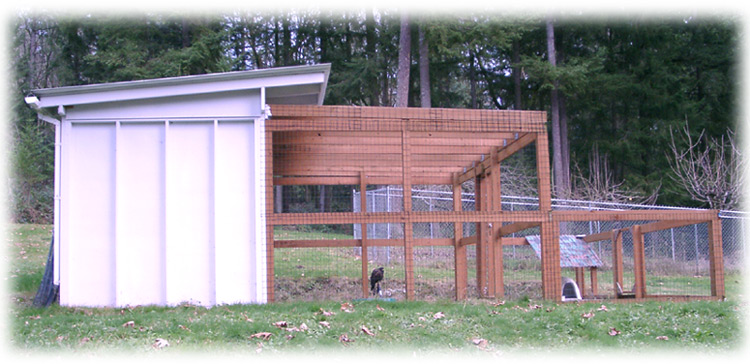 |
| From the right hand side, the falconer first enters into the dog pen complete with shaded dogloo. Then the falconer enters into the weathering yard. On the right hand side of the building is the entryway which leads to a preparation area acting as a double door system for the mews. And from there into the mews. In total there are three locked doors between the bird in the mews formal and the outside making accidental release, or any tampering, almost impossible.
One very nice consideration is the amount of overhang that the mews roof has over the weathering yard. A falconer fumbling with a locked door is out of the rain, and the bird can be moved back under the awning, but still be outside. Also important to this climate is the drainage system. The gutters and pipes directing water away from the mews area is very effective at managing moisture, and important in the rainy Northwest. Also note that the mews is constructed with the studs for the walls on the outside with the plywood for the walls on the inside. This makes for a mews which has smooth walls inside and prevents the bird from perching on inappropriate places. |
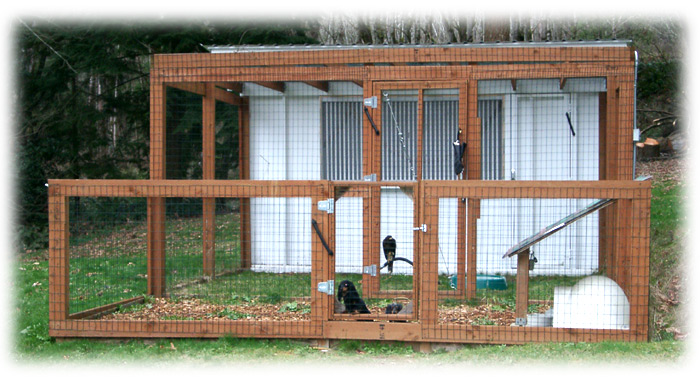 |
| The same mews, from the front. The mews window and door system is more obvious here.
The wire enclosure is made of field fencing which is safe to freeloft in and sturdy enough to keep out coyotes or other dogs. |
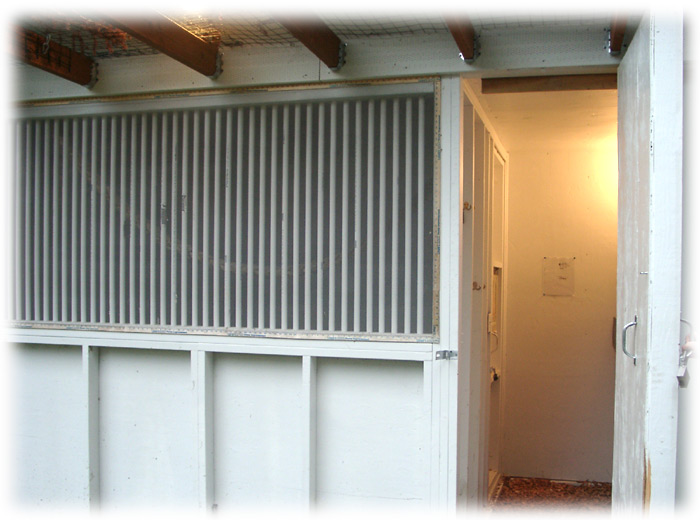 |
| The same mews showing the entryway from the weathering yard into the preparation room. Here the mews window is much more clear. The window features screening on the outside of the bars to prevent mosquitos from entering the mews. The bars are PVC pipes and are strong enough to keep in any raptor. The preparation room is 4' wide by 8' deep making the whole building structure 16' wide by 8' deep.
The preparation room has space for a scale, notebooks, equipment, and storage, but smartly also has a thermometer so the falconer can monitor the bird's environment. |
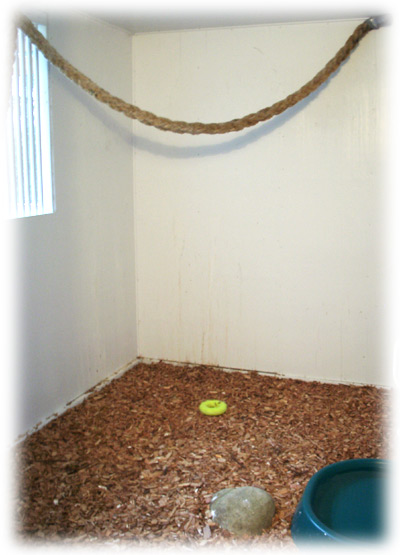 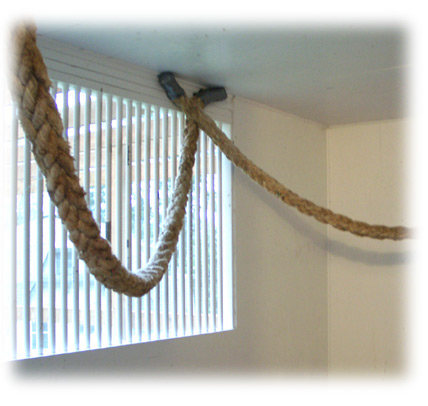 |
| The same mews showing part of the inside. The mews features two rope perches, a large bathpan, and a rock for the bird to feak on if she chooses. Where the wall and ceiling meet, quarter rounds have been put in so that the bird cannot find a way to perch on the edge of a sheet of plywood.
The walls have two undercoats of primer and two coats of enamel paint making cleaning them easier. The ceiling is 8' high, but does not meet up with the slanted roof pictured on the outside. This space between the inner ceiling and the outer roof provides insulation and helps keep the mews a constant cool temperature during the summer months. The flooring is an 8" deep base of cedar wood chips. |
Mews and Weathering Yard
Mews designed and constructed by W.J. Miller and Baine Carruthers - falconers each
Located in the South, this mews has to take into consideration large amounts of strong sunlight, heat, and rain. Insects are also an issue. With the temperature and moisture, mold and fungus is an issue which means guarding against Asper aggressively. The falconer reports he has had no problems at all with moisture in his setup with the gravel flooring base, pine bark, and deep trench for drainage.
Features
- Hybrid mews (12' x 12') and weathering yard (12' x 16')
- Preparation room with refrigerator and freezer
- Electricity
- Variety of perches including natural branches, bow perch, and Astroturf covered shelf perches
- Pine bark flooring and pine needle flooring; flooring has 2" of gravel covered by 4 - 5" of pine bark and then 4 - 5" of pine needles
- Slated roof over area allowing natural light and rain
- Sliding door that can be closed during wind or ice storms
- Whole walls of slats allowing visibility and good ventilation; slats have 1.75" of open space between each slat
- Slatted walls have inserts which make them solid; useful for wind storms or flighty birds
- Must be able to build things
- In too frigid of a climate, the bird may not be well protected enough
- Some birds may not be calm enough to be free lofted in a mews such as this. Birds may need to be tethered or have smaller areas of visibility.
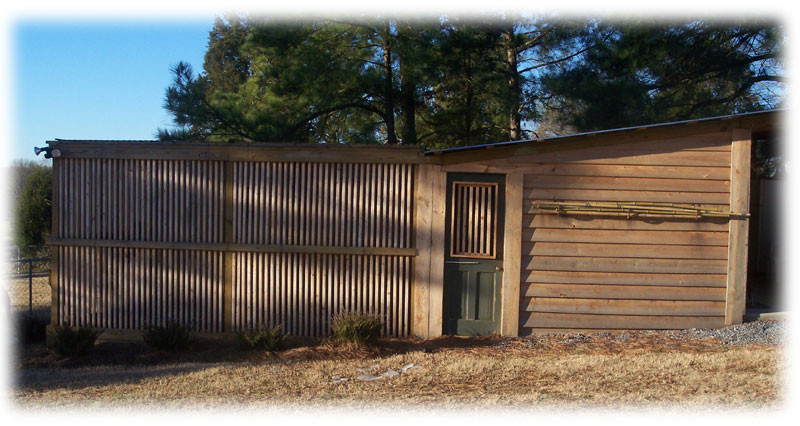 |
| The falconer first enters into the preparation room. The door opens into the room and there is a spring to ensure it stays closed. There is electricity running to this mews so there are floodlights placed at the corners. The tall trees provide additional shade keeping the temperature moderate but allowing enough light in to satisfy the bird's needs.
Photos courtesy of Baine Carruthers. |
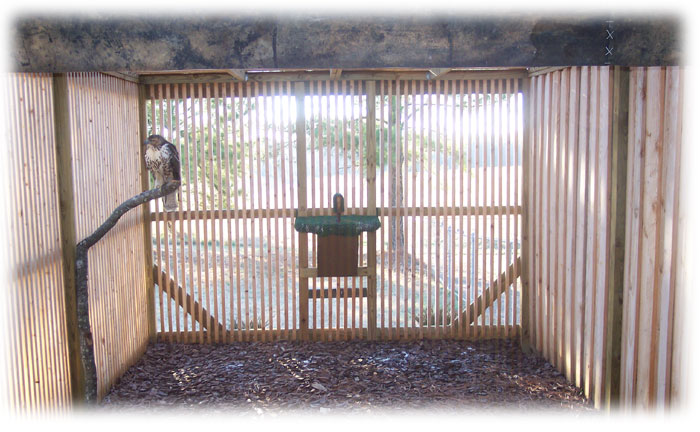 |
| The far end of the mews is more of a weathering yard featuring 5" of pine bark as the flooring and a slatted roof letting in natural light and rain, should the bird want to bathe, or a large bathpan should she want to dunk herself. There are several perches of varying material and diameter. All are placed to give the bird enough distance from the wall to not damage her feathers.
Photo courtesy of Baine Carruthers. |
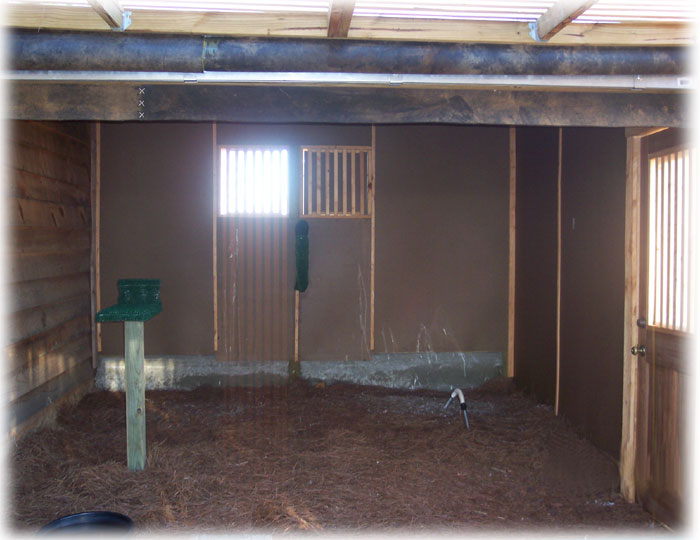 |
| On the interior side of the mews, the flooring is 4 - 5" of dried pine straw over 4 - 5" of pine bark. The walls are smooth to not allow the bird to perch on any unintended surface. The door opens in and has enough visibility for the falconer to view the bird before entering. Note how the door has also had bars added to the door for safety. What is lost in the two shots above is a drain and track for the sliding door. The open weathering area and the enclosed mews can be separated by the solid sliding door. This can be useful for securing a bird in inclement weather or for acclimating a bird to freelofting.
Photo courtesy of Baine Carruthers. |
Falconry Facility - Mews and Equipment Room
Mews of the US Air Force
Located at the US Air Force Academy, this mews is the state of the art. Each mew room features an easily cleaned floor with drainage system, adequate perches, open air windows, skylight, and food chutes in the doors. There are both individual mews and breeding chambers in the facility. Most mews do not need to be built to this degree, however with the number of people involved, the number of birds involved, the number of activities conducted, and the number of public visitors, this level of facility is required for this situation.
I'd like to thank Lt. Col Muldoon and his cadets for the opportunity to be behind the scenes with them.
Features
- Multiple mews (12' x 12') each with window and skylight
- Preparation room with refrigerator and freezer
- Electricity and plumbing
- Variety of perches including Astroturf covered shelf perches
- Very expensive!
- In too frigid of a climate, the bird may not be well protected enough. These birds are brought into the climate controlled sections if conditions turn too cold. The windows could be sealed on the outside during inclimate weather to prevent the birds from becoming overly cold.
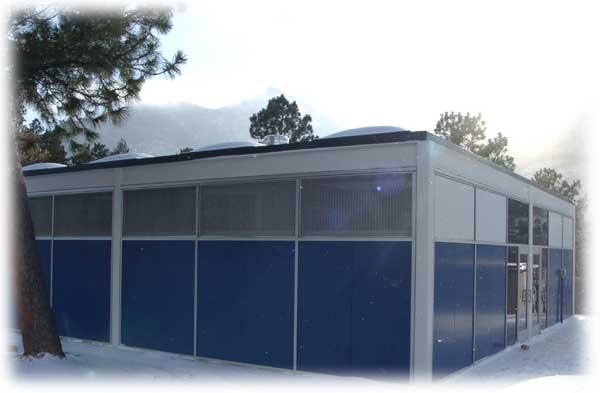 |
| The exterior of the mews. Here you can clearly see the entrance to the equipment room. Each bay of windows is a mew - each mew space has a large external window and a skylight. |
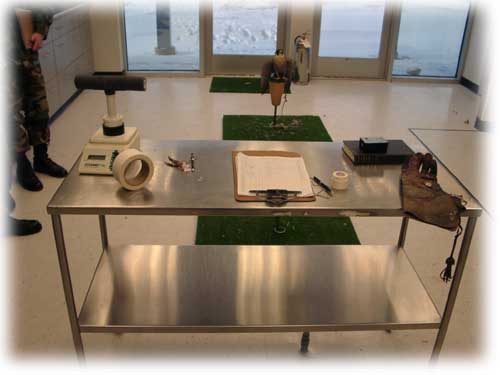 |
| On entering, the facility features a large preparation and equipment room. The linoleum and stainless steel allows for easy cleaning and is, as everything else, immaculate. |
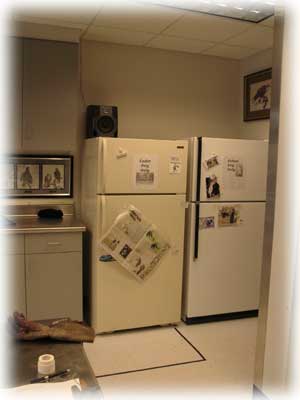 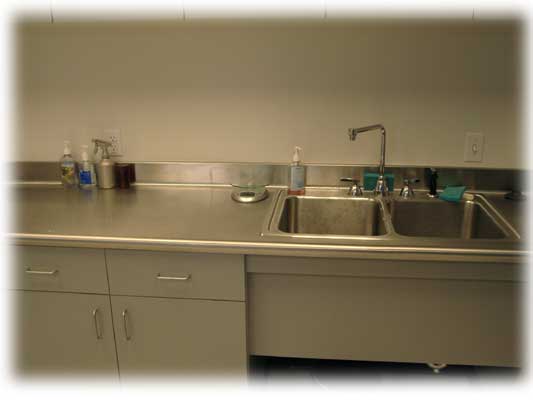 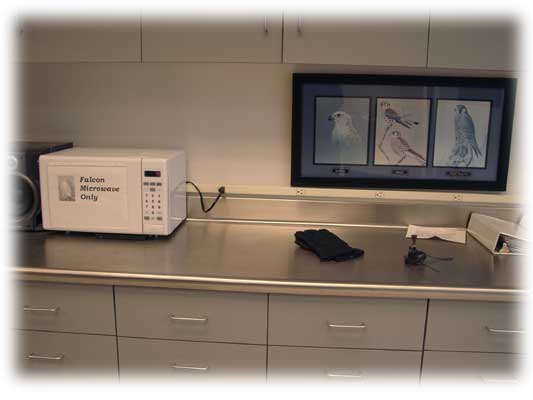 |
| The preparation room and equipment. |
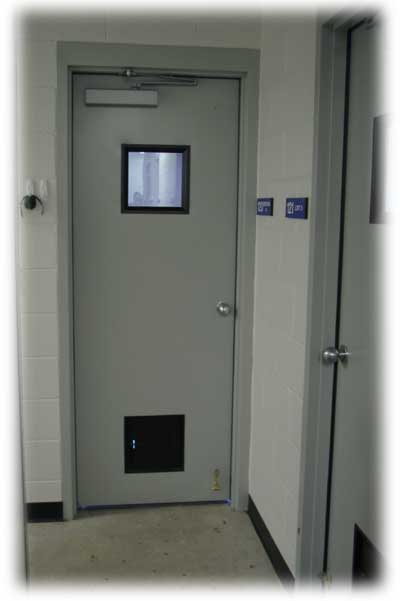 |
| The interior of the facility has several hallways leading to the mews themselves. The concrete floors and painted concrete block structure are easily kept immaculately clean and orderly. Hoods for each bird are hung on the hooks next to their doorway. |
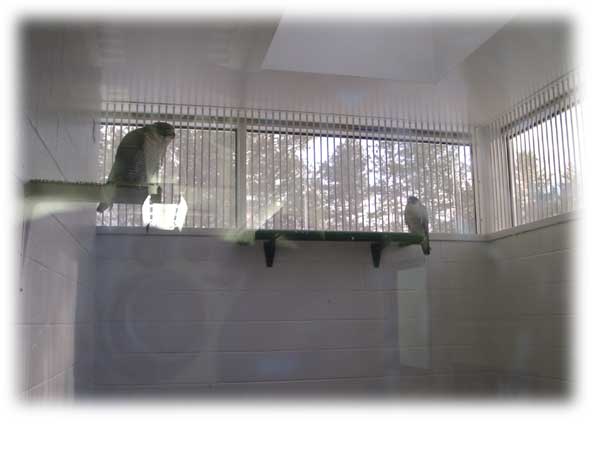 |
| The interior of a breeding chamber of two Peregrines. Skylight and windows are evident here. Walls are concrete block allowing them to remain cool in the summer. |
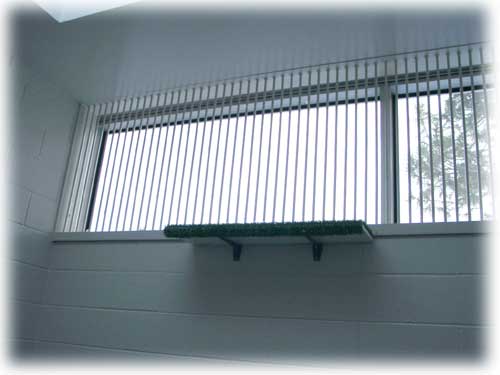 |
| The interior of a mews window. The windows are barred preventing birds from striking the window, and they are screened allowing good ventilation, but preventing insects from entering. |
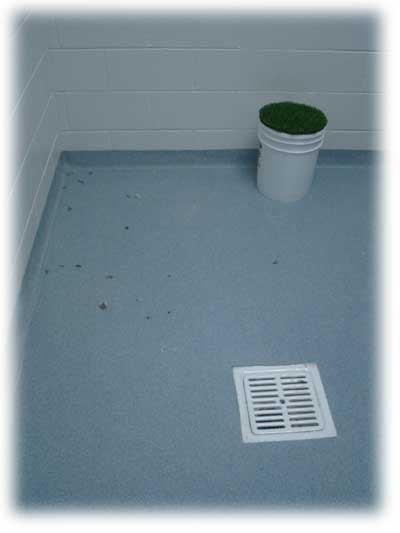 |
| The mews floors - easy to clean or sterilize with excellent drainage. Note: These are not mutes, but a few feathers drifting around. |
Rehabilitation Facility - Mews and Equipment Room
Mews of the South Plains Wildlife Rehabilitation Center's education birds
Located in Lubbock, Texas.
I'd like to thank Rob and Carol Lee for the opportunity to be behind the scenes at their facility.
Features
- Multiple mews (12' x 12') each with window and skylight
- Each mew has a security screen door allowing viewing the bird in the mews as well as good ventilation
- Pea gravel base over dirt
- Bathpans in each mew
- Hole in front to slip hose into for filling bathpans easily
- Windows are 5.5' high
- Hardyboard walls
- Electricity and plumbing
- Electricity and plumbing
- Very expensive!
- In too frigid of a climate, the bird may not be well protected enough.
The mews features vinyl coated steel wire mesh ceiling available from aquaculture suppliers. While it is safe if a bird grabs it and sturdy enough to protect from external predators, it tends to warp in heat or too much direct sunlight.
The metal conduit bars for the windows are set with 3/4" gap between each bar (small enough to hold a kestrel). Don't bother drilling the holes under the window bar pipes as it is unnecessary.
Windows face west which gives good direct sun, but also gets overheated during summer. This will be solved with an awning made of enameled corrugated metal.
Shelf perch and other perches Tree stump perches Hardyboard is an excellent material for mew walls as it is sturdy and easy to clean, however be careful with a power washer as it can break down the board. Don't use nails, use sheetrock screws.
Use silicon calking for calking jobs (not the waterproof latex kind)
If using metal conduit for window bars, make the windows 4' high maximum - 5.5' is unnecessary and allows pipes to flex a bit too much.
Mews floors are compacted dirt with pea gravel over surrounded by concrete. This makes the mews floor a pool of water when it is cleaned. French drains or something would help solve the drainage problem.
And finally, I was surprised by Rob's advice regarding the most stunning feature of this facility. Don't do a curve! Nothing is a straight line and everything is constantly under stress - walls are curved, gutters have to curve, etc. This is more effort than necessary.
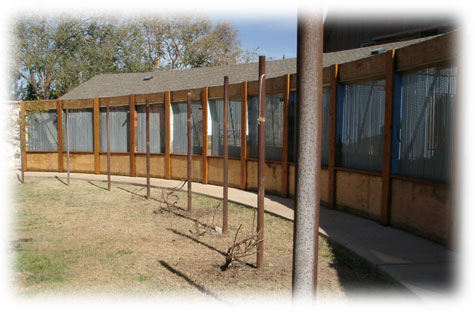 |
| The exterior of the mews. Here you can see the external curve to the structure. The awning planned will extend from the roofline out to the posts in front of the walkway. |
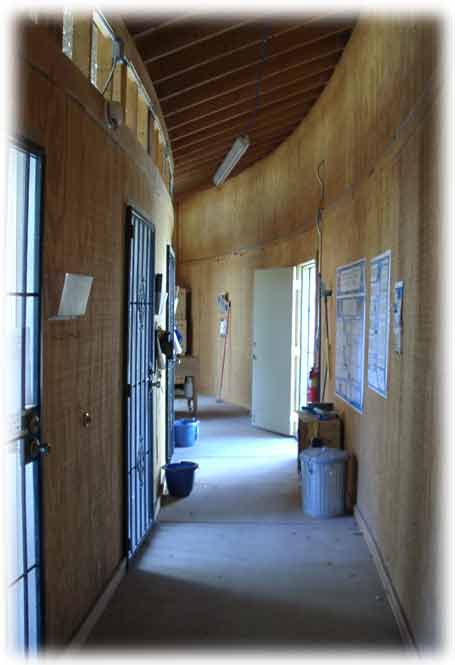 |
| On entering, the facility features a long curved hallway with security screen doors opening in to each mew. |
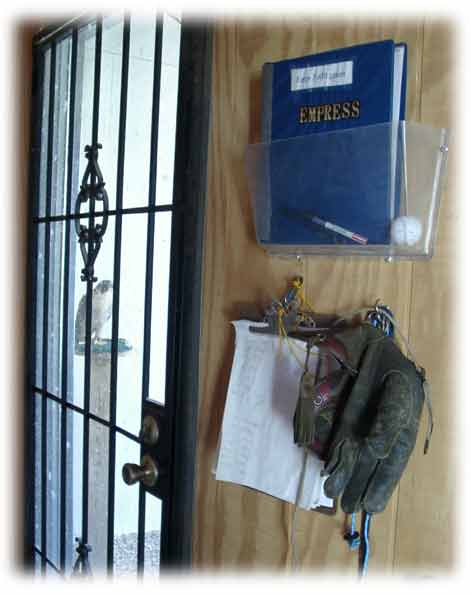 |
| Outside of each door are the bird's furniture and notes. |
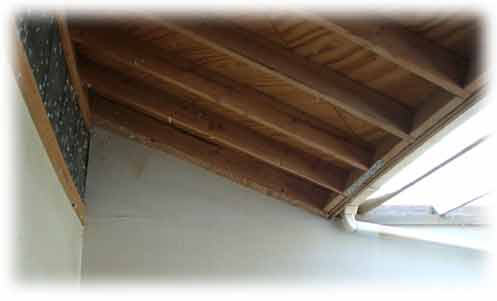 |
| Details of the mews ceiling construction. |
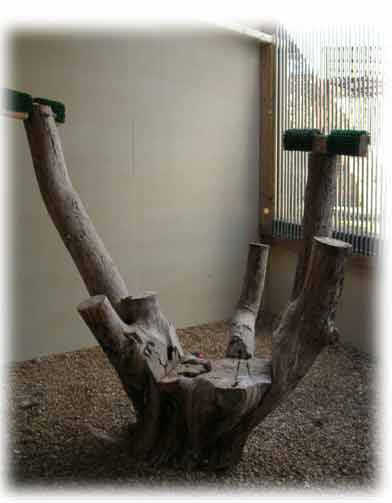 |
| A beautiful tree trunk selvaged from a tree that had to be cut down makes a stunning perch in one of the display mews. |
Flight Cage Aviary
Flight Chamber of the South Plains Wildlife Rehabilitation Center
Located in Lubbock, Texas.
I'd like to thank Rob and Carol Lee for the opportunity to be behind the scenes at their facility.
Features
- 50' x 34' Flight chamber
- Galvanized steel hat channels set 3/4" apart (make sure they have rolled edges)
- Finished on the inside, not on the outside
- Doors on each side, in case of emergency a handler can escape
- Solid metal around bottom contains any live prey released to test the rehabilitation bird's ability to hunt, and therefore be released
- Very expensive! Materials: $8,300 Labor: $2,000
- An exercise facility only for rehabilitation or education birds, not a permanent housing facility.
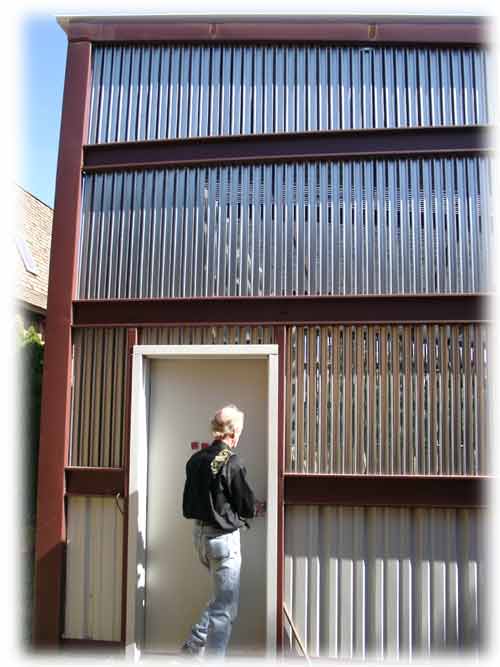 |
| The exterior of the flight chamber. |
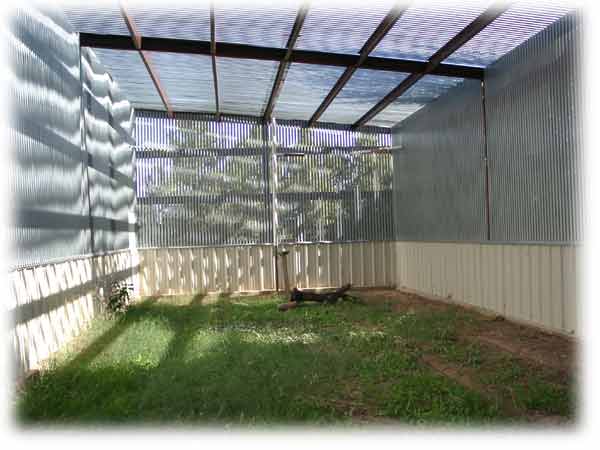 |
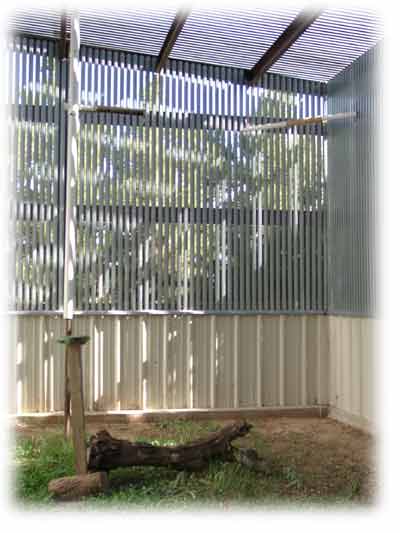
| Interior of the flight chamber. Notice how light and bright it is, yet protected from wind and sun. |
 |
| Perches in the flight chamber. The birds rarely use the perch in the foreground and far prefer the perch in the upper corner. Birds will want to go to the highest corner on each side, so provide a perch there. |
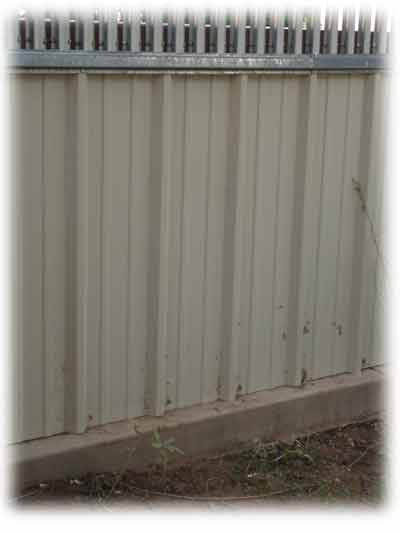 |
| Details of the construction. Notice the hat channel vertical bars. Each hat channel is screwed in on either side. The bottom of the hat channel verticals is covered with a horizontal piece. Solid metal with a concrete base secures the flight chamber. |
Mews
Mews designed and constructed by falconer Jo Turley
Jo Turley provided some commentary on the design choices for this mews.
We didn't put in a floor drain, and should have, though it can be done retroactively when/if we really need it. It is not (yet) suitable for free lofting because the inside around the eaves has ledges the hawk might want to cling upon. I don't free loft, so that isn't an issue for me. Ditto the heavy duty grill vs vertical bars - we felt the grill was better at keeping moose heads out of it. Also, it doesn't have a safety door, but that could be an easy add-on. We had to be able to move this mews on a flat bed 100+ miles, so kept the design simple and sturdy. What I like is the amount of fresh air and light and view the hawk can get, with shuttering for hawks that need darkness and temperature control. It is wired so we can have light, heat, and so we can also set up a heated drinking bowl. Since I tether and don't feed in the mews, cleaning is amazingly simple - on the astroturf mats, all around the perch, I keep an area an inch deep in spruce shavings. I scoop the dirty shavings several times a week and add fresh. The slices can't reach the walls.
We are going to put a fish eye lens in the door so as to check on the hawk before we open it - especially useful if the mews has been partially shuttered while in the early phase of training a passage bird.
My Red Tailed Hawk used it for 5 years with no problems. I kept a garden chair in it, and would have my morning tea with my hawk almost every day of the year - he would sit on my knee the while.
Features
- Roomy mews with windows for light and ventilation
- Equipment cabinet with perch designed for weighing
- Electricity and plumbing
- Cement roof
- Radiant heater installed in roof
- Wooden shutters for windows, and a pair of plexiglass inserts to block wind but allow full light on colder winter days
- Floor and lower wall is painted with Ducan Sundeck Coating as it is waterproof, rubberized, permanently flexible,
non-skid.
WARNING: Hypalon fumes can cause severe headaches (in humans and presumably in animals).
Use only in well ventilated area and ventilate extensively before ever introducing an animal.
- Must have space and finances to build
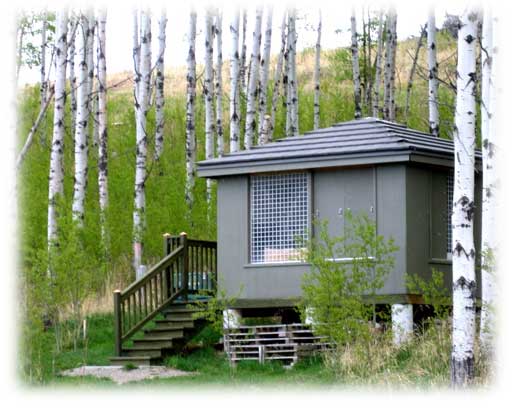 |
| Mews is set away from roads or vehicles. |
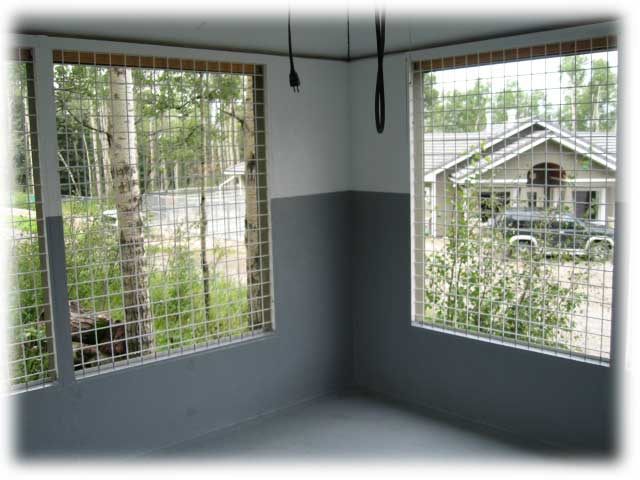 |
| Interior of mews. |
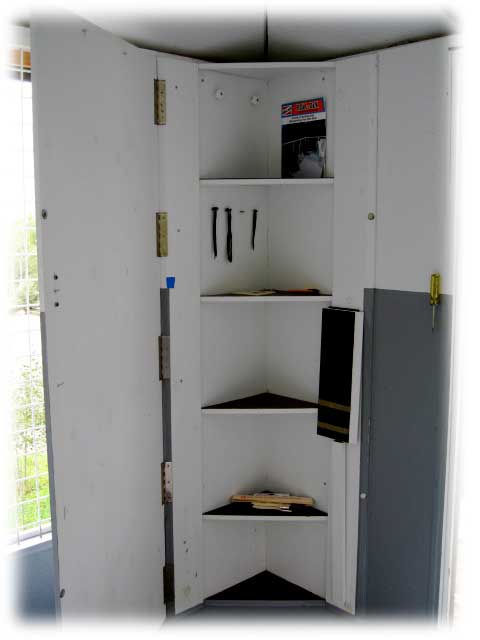 |
| Corner cabinet for equipment. |
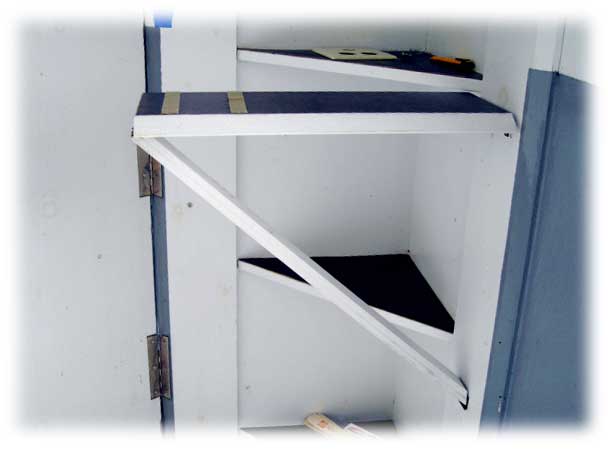 |
| A jointed perch. Note the velcro strips for holding a scale in place. The narrow perch allows a hawk's tail to hang strait down. |
Open Air Aviary Mews
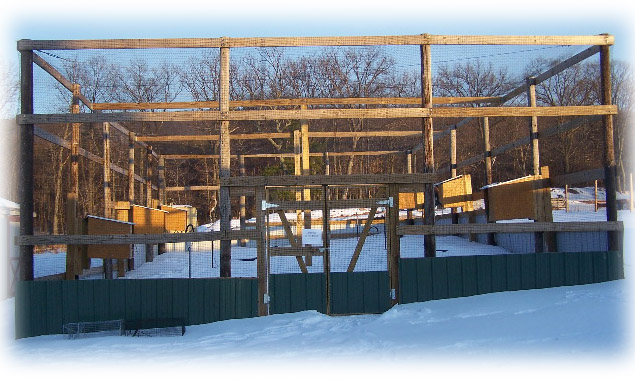
Mews designed and constructed by Jason Caldwell - falconer
Features
- Great ventilation
- Many perching options
- Must have significant amount of space
 |
Night Mews
Mews designed and constructed by Ron Kearney - falconer
This particular mews is mostly used at night. The birds are working birds and therefore are not kept in the mews during the day. They are hooded and placed here for the night.
Features
- Screen perch accommodating many birds at the same time
- Efficient use of suburban space - this was part of a detached garage
- Must have a separate weathering yard
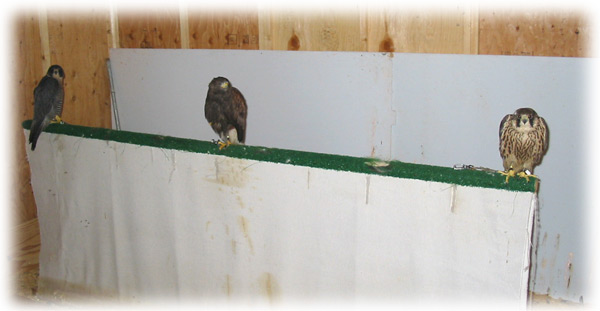 |
| This mews is very traditional in the way birds are tethered on screen perches and many birds are housed together. |
Indoor Setup
This particular mews is inside the house, however is actually very clean.
Features
- Constant socialization with falconer
- Efficient use of suburban space or urban space
- Must manage this appropriately, such as cleaning regularly
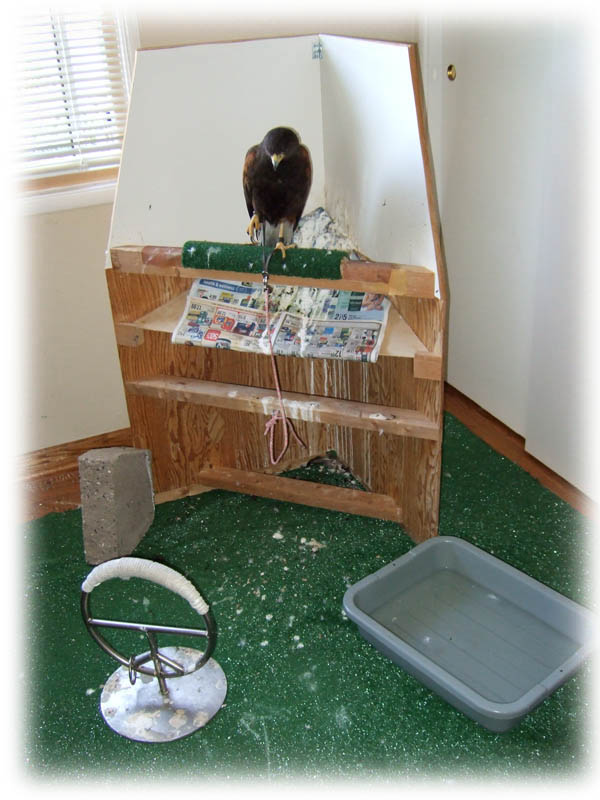 |
| This mews could actually be considered very traditional as many cultures have kept their falconry birds inside their home with them. |
Kestrel Mews
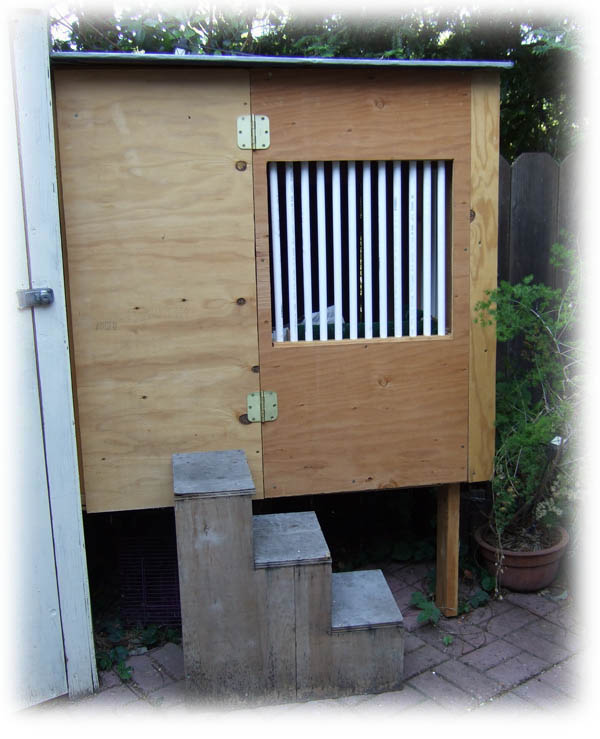
This particular mews is outside in California where the temperature weather works well for such a small bird. In climates with very cold weather a Kestrel may be better kept inside.
Features
- Mews scaled to the Kestrel yet convenient to access
- Efficient use of suburban space
 |
Outside Trolly System
Mews designed and constructed by Derry Argue - falconer
This is a trolly system whereby the bird is leashed, but instead of being leashed to a single point, the leash connects to a long line running between two perches. The line must be clear of any obstruction and the bird must not be able to get caught or hung up on either perch. The bird then has the choice to be out in the sun or rain or to seek shelter in her hut.
The trolley system was explained to me by a French falconer, Henri Desmont, and is not my invention. I have had my male parent reared goshawk on this system for two and a half years, 24/7, and he has not broken a single feather. Obviously, falconers may need to adapt it to local conditions. The trolley system has the hawk tethered to a ring on a tensioned wire between two small huts for the bird to roost in. It seems to keep the hawk reasonably fit as my goshawk caught two January pheasants on the wing after I had stopped flying for over a month. My set up is surrounded by electrified sheep netting but in some areas it would also need to be protected from avian predators.
On my set up the wire is stretched between two angle iron stakes, each one beyond the back wall of each hut. The wire I use is a single strand of galvanized high tensile steel fencing wire, 2.5mm diameter, as used for permanent electric fencing (which I just happen to have handy!). The wire is tensioned by an ordinary fence line tensioner beyond one of the huts.
The leash is tied to a stainless steel ring, link, or small yachting pulley that runs on the wire. There is a "stop" clamped to each end of the wire preventing the ring running too far - you want to keep the leash reasonably taut so it doesn't snag on anything in the hut or on the perch. The wire could be any length in theory.
The perches I use in each hut are 2" diameter hardwood (cut out of the woods). One side is cut to leave a flat surface, then this is bolted to a steel bracket (1"X1") which is in turn bolted onto an upright at the back of the hut.
I have had the bird straddle this perch, then turn, so twisting the jesses onto the perch. I have countered that by (a) fixing windbreak material beneath the perch, and (b) fixing a wire from the end of the perch to the ground.
I cannot stress too strongly that you need to go over the whole set up to make sure nothing can snag or work loose. That is also the reason for the wind break material under the bow perch. (And, no, it isn't a little shelter for the hawk as someone suggested).
Derry Argue
https://www.versatiledogs.com/kdb/search.php?homePage=kennel&id=1334
Features
- Protection from some of the elements
- Allows the bird freedom of choice in her perches and exposure to sun or bathing in rain
- Keeps the bird in her native environment out of doors
- Bird is always acclimated to the weather
- Inexpensive
- Excellent ventilation
- Not fully protected from other animals
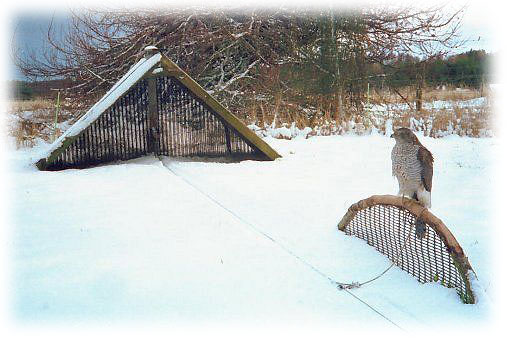 |
Note the orientation of the perches that allow the bird to be safe in this setup.
Photo courtesy of Derry Argue. |
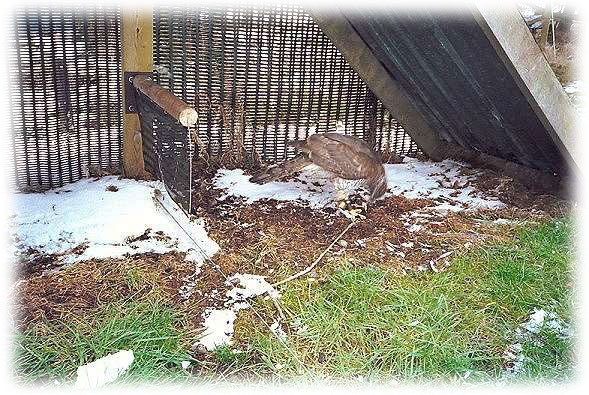 |
There is a screen preventing the bird from passing under the perch inside the hut. This is all in place for safety.
Photo courtesy of Derry Argue. |
Aviary Style Mews
Mews designed and constructed by David Maritz - falconer
This is a large aviary style free flight pen measuring 24' x 12' x 8', but with 4' of space dedicated to a double door, one of the aviaries is only 20' long. The frame is from a pergola structure of 2"x4" boards with the wall of an existing structure used as one of the long sides of the aviary. The walls are large gauge field fencing (2"x4" wire) outside of white sunscreen panels. The wire mesh prevents predator entry or the bird's escape should the sunscreen rip. The birds held in these particular aviaries are Goshawks who are known for their erratic behavior. The softer walls help prevent injury should they fly about careening into a wall. The woven polyurethylene sunscreen material allows in plenty of light, yet it is always slightly dimmer inside the aviary than outside. Because of this, the birds can easily see out yet passers by cannot easily see in. In fact, many people who routinely are near this structure don't even realize that there are birds inside, yet the birds themselves have the opportunity to acclimate to people, dogs, cars, and traffic without harm.
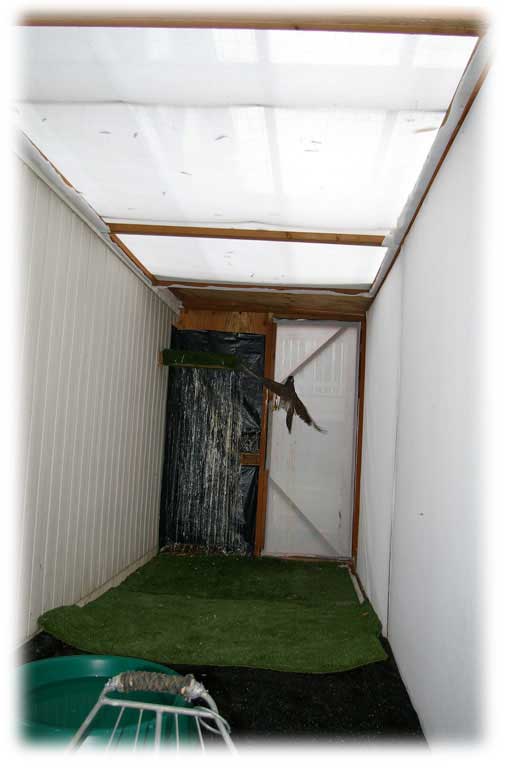
The substrate to this structure is a flat concrete foundation covered with sand which is then covered with Astroturf. There is a 4' plywood roof over one end of the aviary providing a roost and rain shelter for the bird. Behind the roost perch is plastic for easy power wash cleaning of the mutes every few weeks. At the opposite end of the aviary is another high perch in the open and the center area has several low bow perches and a large bathpan. The entrance to the aviary is a two door chamber entry which has been effective at preventing escapes.
A dog pen has been added next to the aviary allowing the hawks to be exposed to the dogs daily and make them part of their environment.
The mews is located in the mild climate of the Northwest, but similarly styled structures are used for mews in a variety of climates including hot, dry, arid climates. Concerns in those locales would be the exposure to the weather extremes (temperature and wind primarily), and providing adequate shade and the appropriate temperature for the species in question. An aviary like this could easily be outfitted with a light spray sprinkler system to cool the area by 10° or more.
David adds that the wisteria in bloom in May makes for one of the most beautiful blossom adorned mews in the world.
Features
- Protection from most of the elements
- Allows the bird freedom of choice in her perches and exposure to sun or bathing in rain
- Bird is always acclimated to the weather
- Allows bird to constantly be acclimated to people, dogs, and traffic
- Soft walls without perches or ledges that will encourage damage to feathers
- Excellent ventilation
- Allows good exercise flying between the perches
- Variety of perches including swinging rope perches, bow perch, and Astroturf covered floor
- Well camouflaged to the casual on-looker
- Fairly expensive to build
- An easily stressed bird may need more cover to feel secure
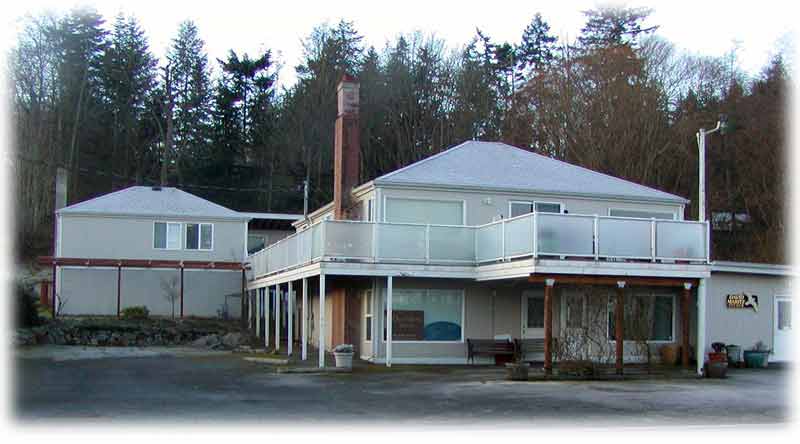 |
| The house and mews - note how well the mews blends with this attractive curb appeal (mews are to the left below the brown trellis).
Photo courtesy of David Maritz. |
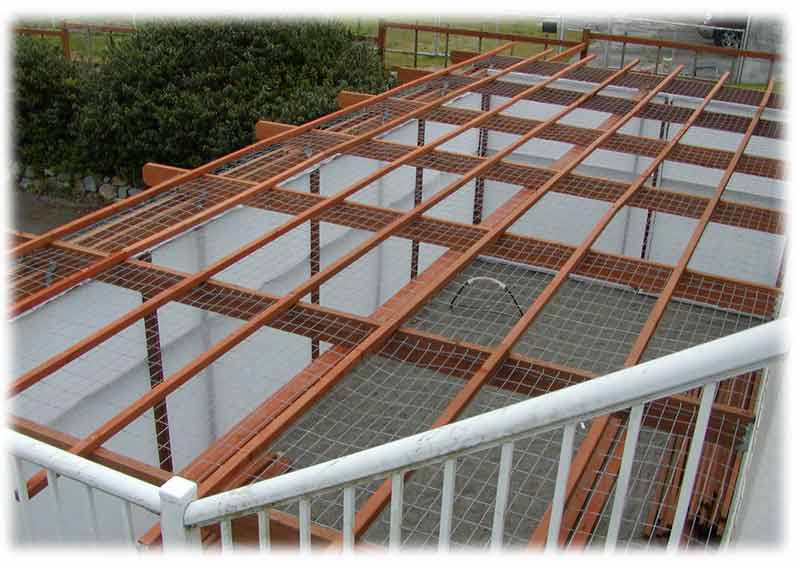 |
| The partially built mews. The roof has been enclosed with wire mesh, the walls have been enclosed with both wire mesh and sunscreen material, and the floor has been covered in sand.
Photo courtesy of David Maritz. |
 |
 |
| The interior of the mews showing the finished walls and ceiling. The sand has been covered in Astroturf and the double door system is visible here. Photo courtesy of David Maritz. |
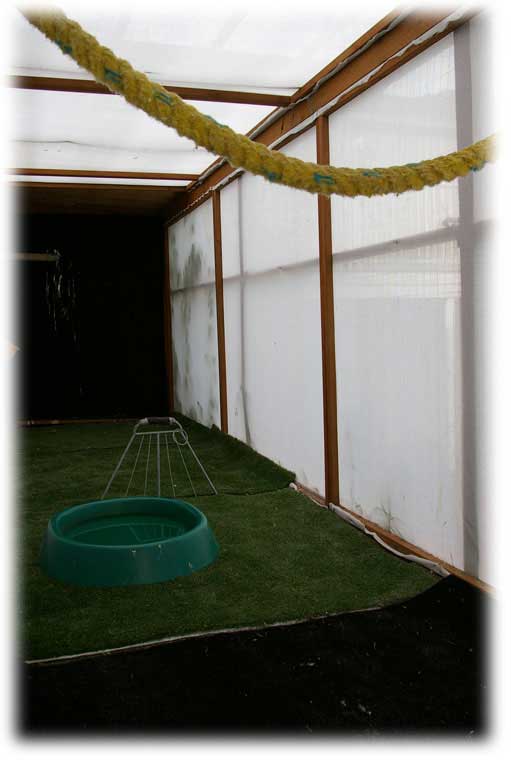
The interior of the mews showing the finished walls and ceiling from the inside. The swinging rope perch is visible here.
Photo courtesy of David Maritz. |
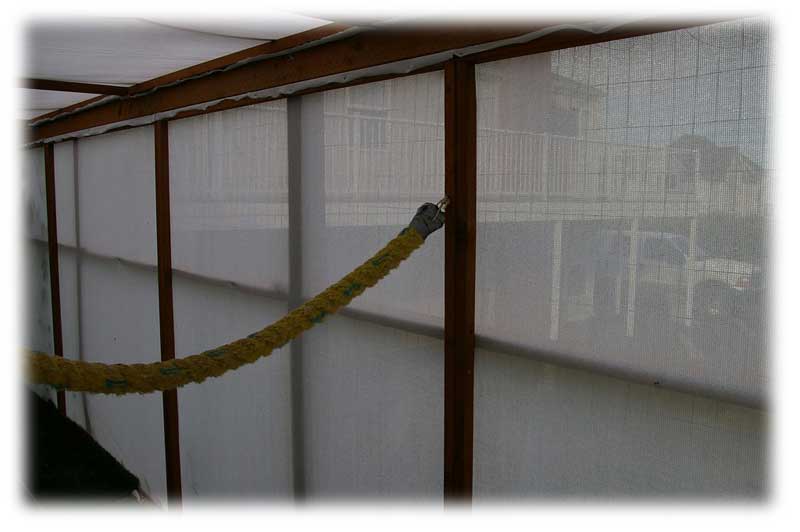 |
| The interior of the finished mews. Although the bird gets plenty of sunlight, she is well shaded. The transparency of the material from the inside is easily seen here.
Photo courtesy of David Maritz. |
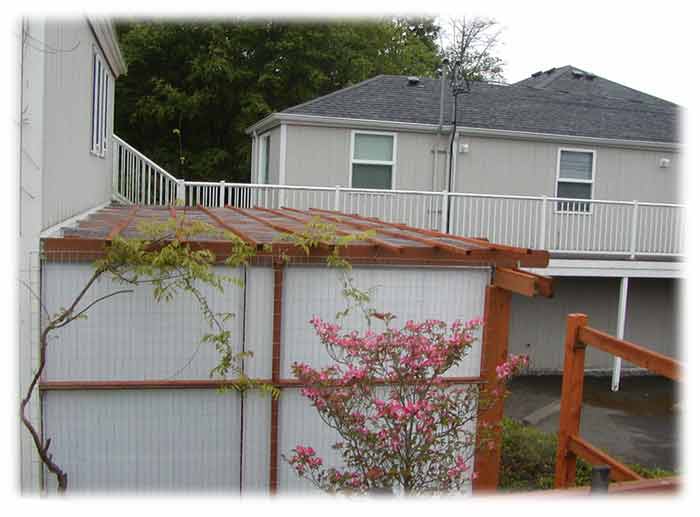 |
| The outside of the finished mews.
Photo courtesy of David Maritz. |
Hybrid Mews
Located in the Pacific Northwest, this mews does not have to consider snow, ice, or many temperature drops. For the few that occur, the bird can be brought into the house or garage for the night or a few days. The hybrid mews/weathering yard gives excellent ventilation as well as exposure to all daily routine. One argument would say that the bird may be over stressed by this, but the other is that the bird is acclimated to it. The bird has plenty of sun, but also enough rain and protection from the elements as well as the temperature.
This particular mews had just been a chain link dog run. When the falconer started renting the house, the landlord permitted a roof to be added to the dog run converting it into a hybrid mews. For a suburban falconer, this setup can be very successful.
Features
- Wire enclosed weathering yard (probably not safe to freeloft most birds)
- Pea gravel flooring
- Efficient use of suburban space
- No preparation area
- No full mews separate from the house
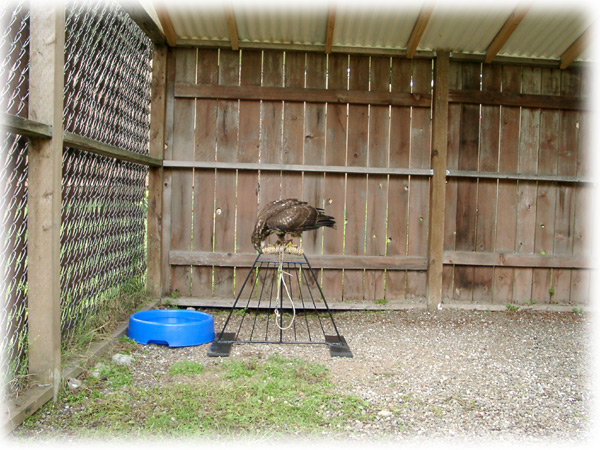 |
| This large mews is a hybrid of a weathering yard and a traditional mews. The bird, obviously comfortable from her feaking, is tethered to her perch. She cannot reach any of the walls to either get a toe tangled or to strike them should she bate. There is plenty of fresh water in her bathpan and although it is a very sunny day, she is well shaded. On cooler days, or for short periods of time, she can be moved forward in the mews into the weathering yard area where she can receive full sun and even rain. This particular mews area could actually hold several birds in this manner. |
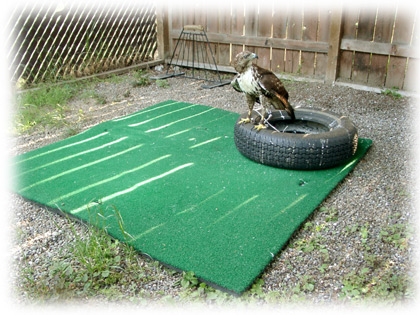 |
| The same mews, but the perch has been rotated out for a tire perch. Instead of using the pea gravel as the flooring Astroturf has been rotated in. The Astroturf is placed in the direction of her bating so that she will not dull her talons on the pea gravel. |
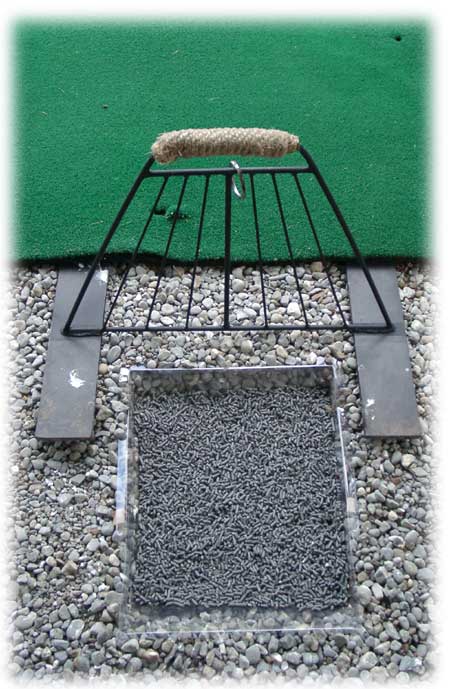 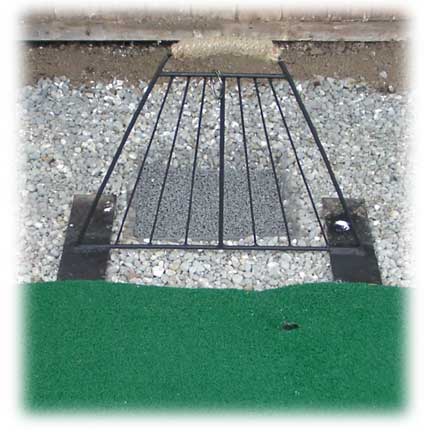 |
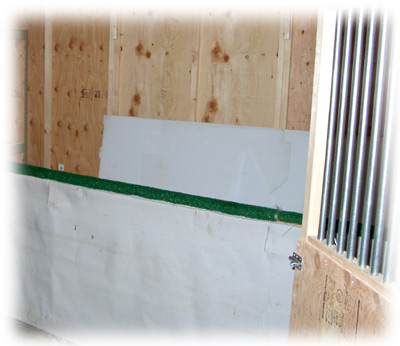
| A litter insert has been added behind the perch. This particular bird only bates forward and onto the green Astroturf. An insert has been installed behind her with compressed newspaper cat litter. This allows for the mutes to be absorbed quickly into the newspaper, an advantage during the damp winters. This also allows for the majority of the mutes to be captured and discarded without hosing down the rocks and leaving the fecal particles in the ground. |
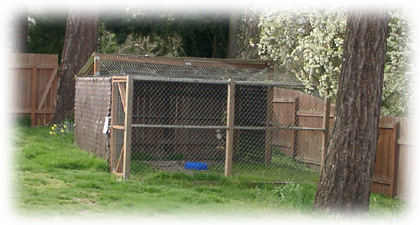 |
| The same mews shown in entirety. Unfortunately the angle belies the size of the mews. Notice the padlock on the mews door accompanied by copies of all official paperwork. |
Desert Mews
Mews designed and constructed by Harry McElroy - falconer
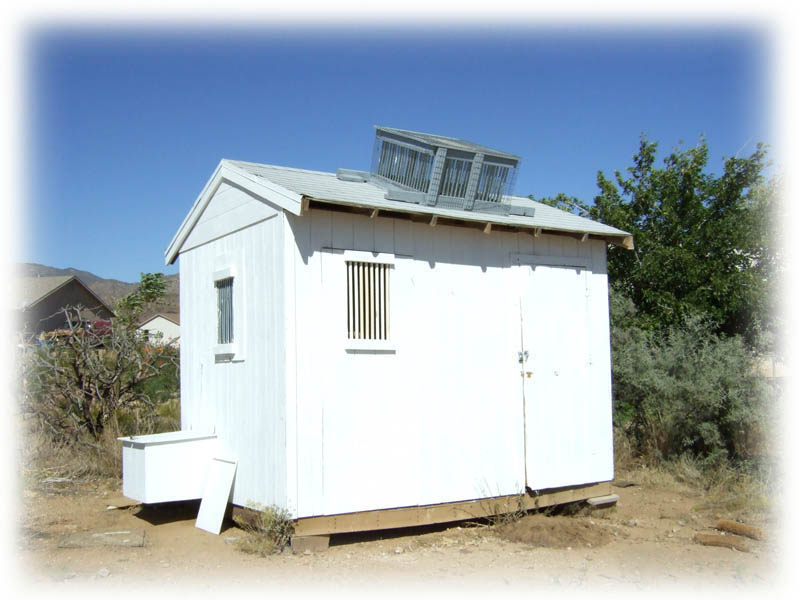
This particular mews is located in hot, arid climate.
Features
- Design refined over decades of falconry experience with Accipiters, hawks, and falcons
- Must have enough space for this structure
 |
 |
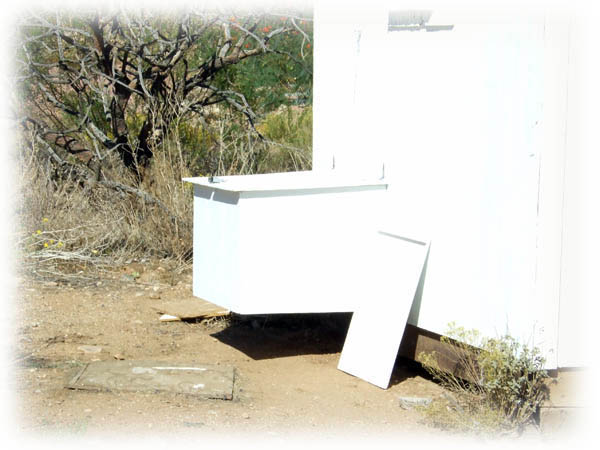 |
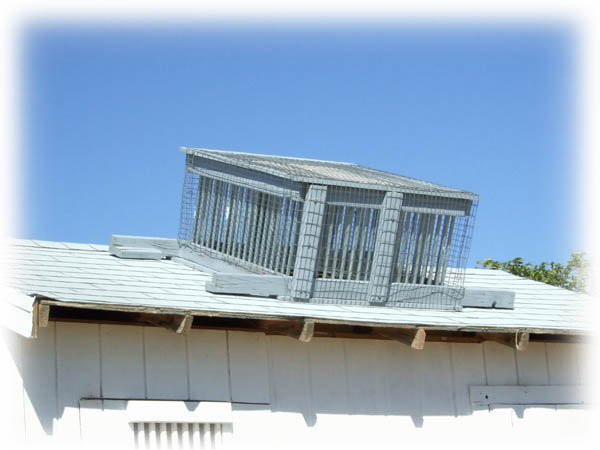
| The box on top is actually a separate room section where the bird can go to sun, perch, or observe the outside. In the hot climate it serves to release the hot air, as well as allow sun into the mews. The bird can choose to sun herself up in the top area, or can remain in the more dim area below. The small box on the side of the mews has a sliding panel to close the box off from the mews. This allows that box to be closed with the raptor inside the mews, the box to be opened, food to be placed inside where the box is then closed and the sliding panel is removed. Any setup like this where there is a drop box for feeding should have additional security, such as a lock or latch on the box to prevent a bird from escaping through the box door. |
Backyard Mews
This particular mews is located in a moderate climate and a very tiny California backyard.
Features
- Efficient use of suburban space
- Must have a separate weathering yard
 |
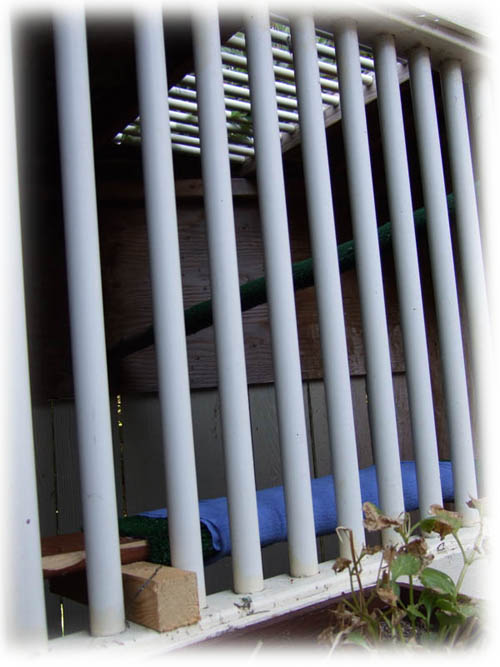 |
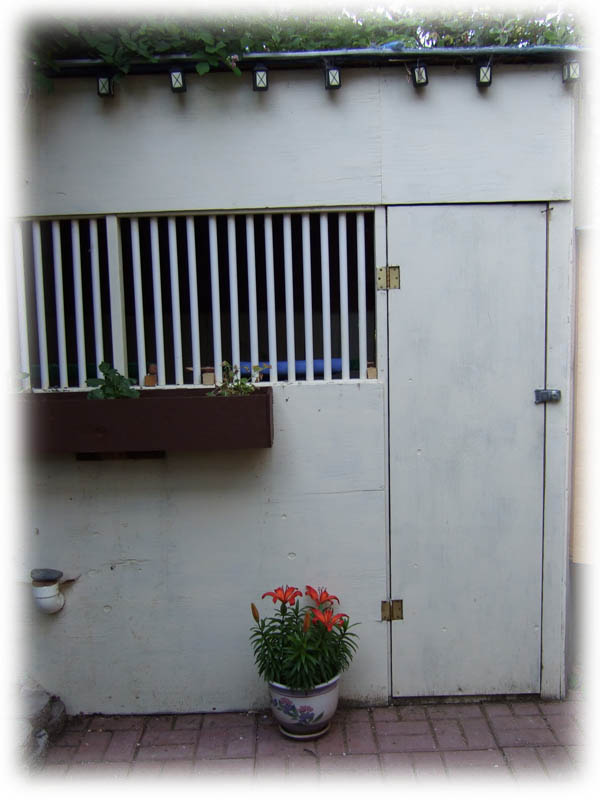
| An easy way to keep a moderately sized hawk or falcon. The window in the ceiling above the perch allows sunlight in as well as rain giving the bird more options. Another perch is placed in front of the window, although about 18" away to prevent feather damage. |
Desert Mews
Mews designed and constructed by Charlie and Pam Kaiser - falconers each
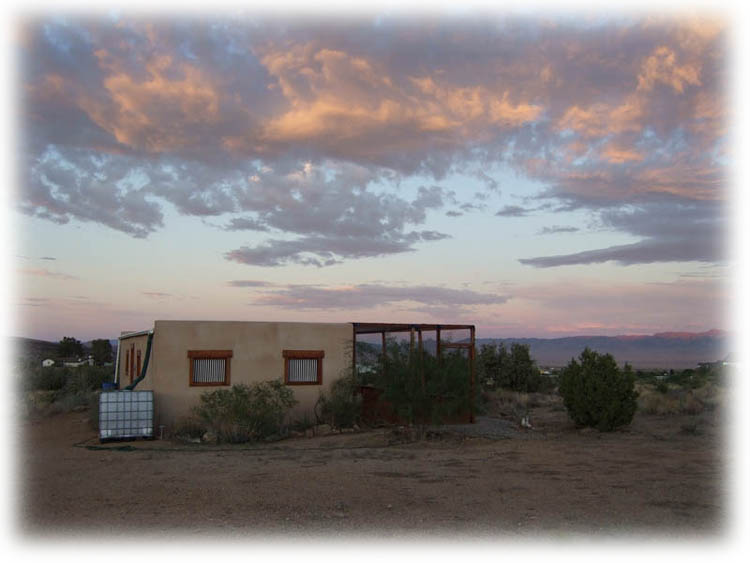
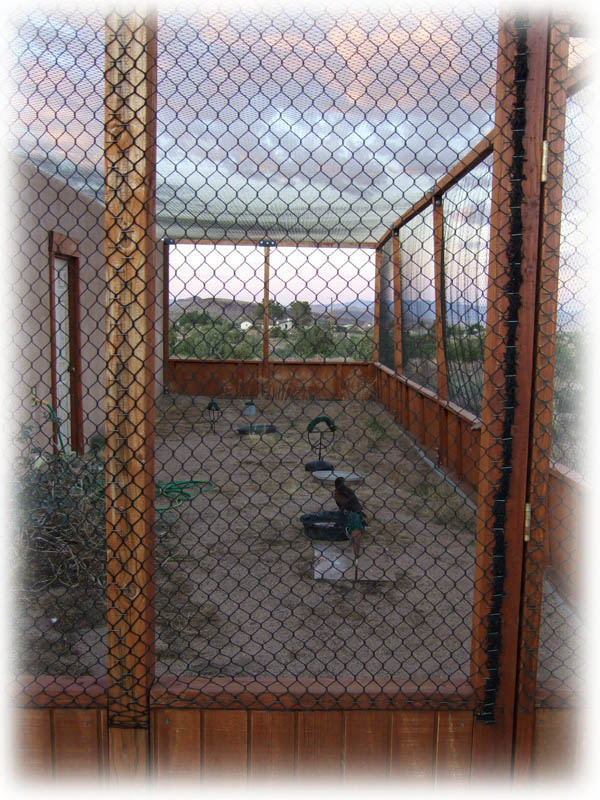
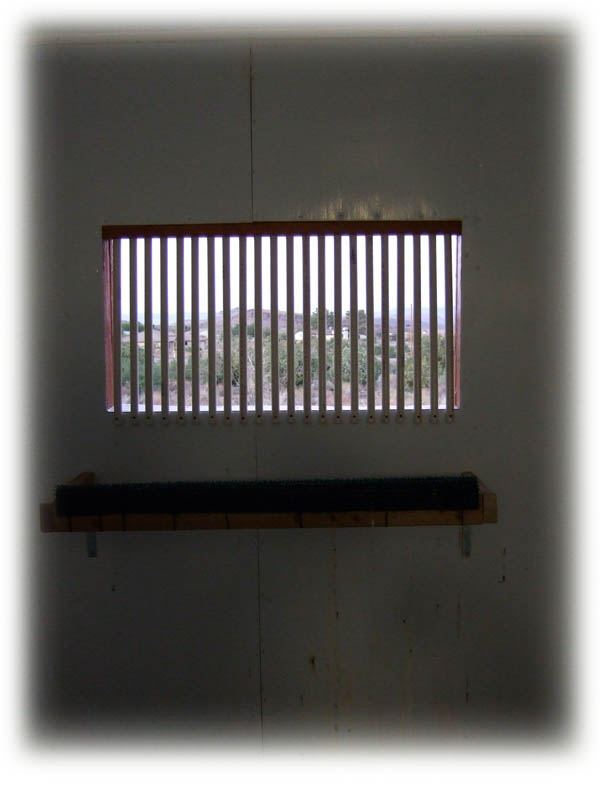
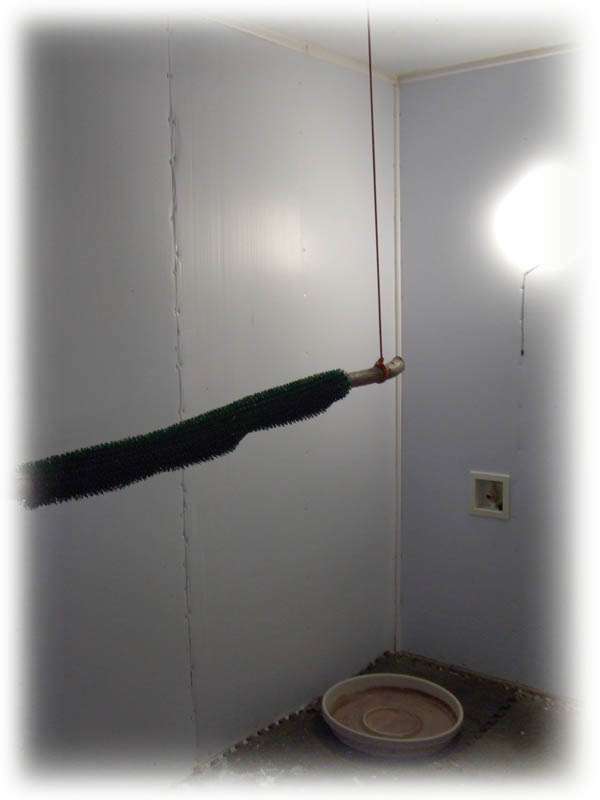
This particular mews is located in a arid, desert climate featuring a full weathering yard and separate indoor mews.
Features
- Beautiful, dedicated space
- Can be expensive to build
 |
 |
 |
 |
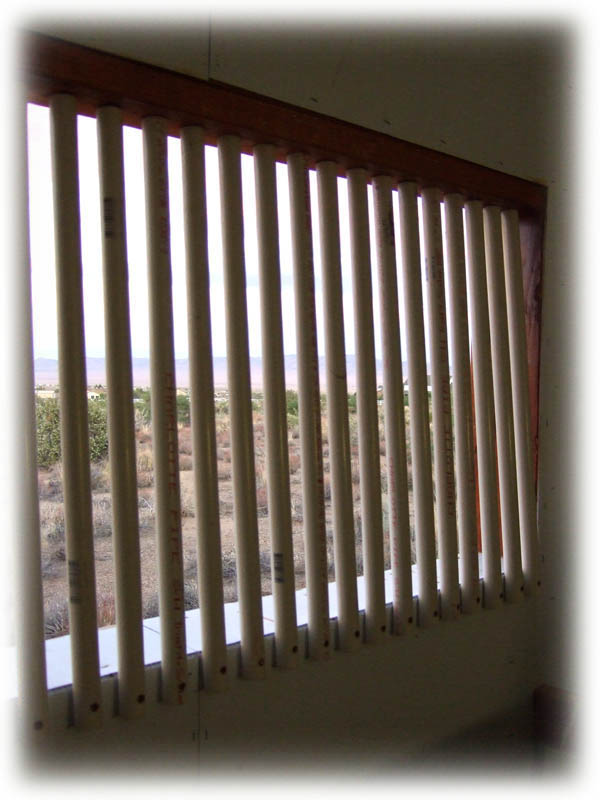 |
| Beautiful facility, dedicated to falconry and their cast of Harris Hawks, everything here is designed for the convenience and effective management of the hawks. |
Backyard Weathering Yard
Mews designed and constructed by Larry Ray - falconer
This particular mews is located in a temperate climate with cold and snowy winters and hot, humid summers.
Features
- Designed solely for weathering a bird well
- Must have another structure for inclimate weather
 |
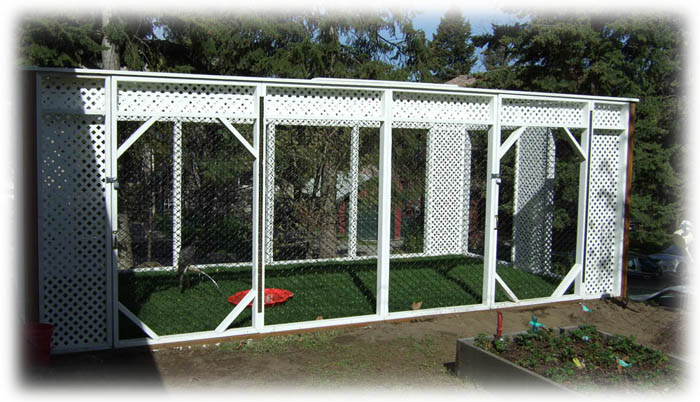 |
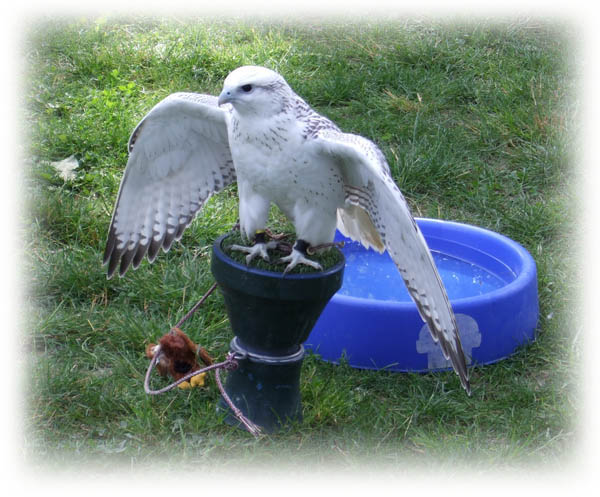
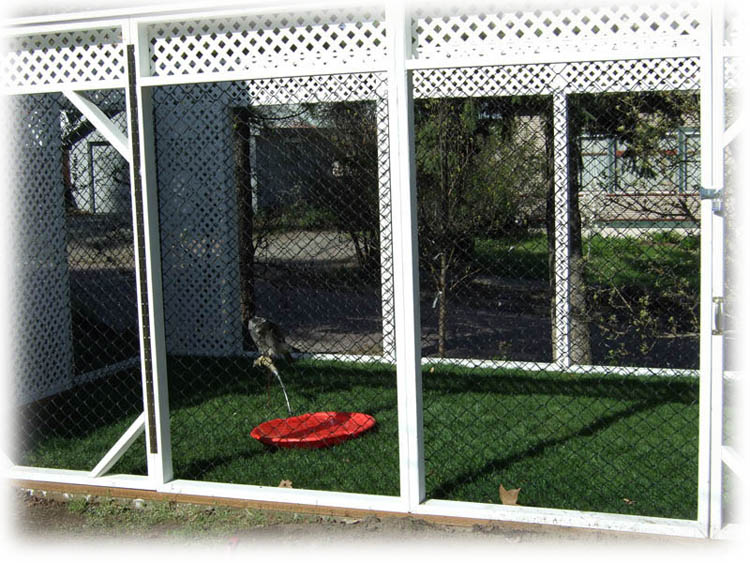
| This lovely weathering yard just blends in with the backyards and structures largely going unnoticed by passersby. The way this bird is managed is by putting her out in her weathering yard every morning, and bringing her in at night, either into the home or the hawk box or the garage. Those who are at home all day may consider a setup like this saving themselves having to construct a mews. The bathpan is a children's dome-shaped sled, which tends to not damage the Goshawk's tail as much as many other bathpan designs. |
House
Many falconers use their house as a mews at least some point. Some even depend on it as a part of their husbandry. For a small falcon like a Kestrel, the constant temperature may be very important. If temperatures drop to unexpected levels, having the ability to bring the bird inside insures her health. A bird may have a perch and matting for her, or just be brought in and placed in her hawk box for the night. As long as she still has enough sun and time outside to stretch and enough exercise and mental stimulation, she will be fine.
Features
- Safety for the bird from wild animals
- Protection from the elements, especially in cold and inclement weather
- No construction necessary
- High degree of interaction with the bird, and therefore more manned bird
- Have to give up part of your house
- Your house may start to smell like mutes
- Falcons tend to mute straight down, so a simple small floor covering is fine. Hawks, however, will slice and shoot their mutes a distance. This can cause trouble in a household.
- Potential safety risk for the bird from household animals
- Carpets hold mold spores and will grow more. Bread molds and the spores end up in the air. There is not a lot of air exchange in the house for some seasons. This can lead to problems for the bird.
- Many everyday activities can have a potential harm to the bird. Cleaning products being used may be at levels that burn her airways. Cooking in Teflon at high temperatures emits gases into the air that we cannot detect. These are lethal to birds. Falconers have lost birds in the past due to Teflon use.
- It requires a change in your own habits to ensure her comfort and safety.
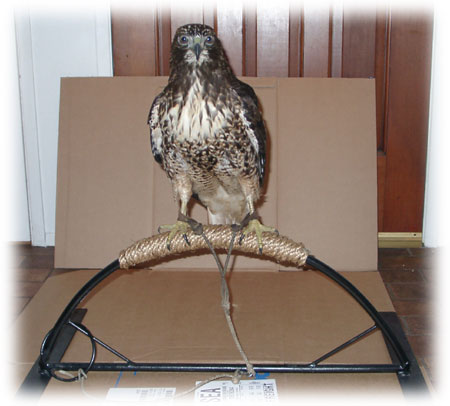
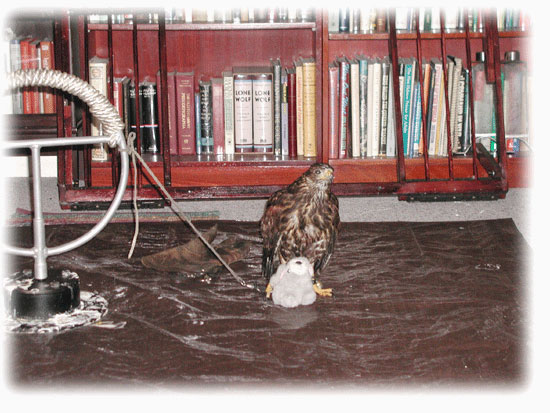 |
| This young bird is set up with a rotating ring perch and toys. A tarp has been put down to protect the carpet and has the advantage of keeping his talons from getting caught in the carpet. |
 |
| A cardboard box makes a great mute catcher for the house. If the bird tends to bate or move around a lot, it is possible for the edge of the cardboard to catch against her leg and rub. Be sure that the edge is not cut in such a way as to make it sharp, or tape the edge in duct tape if your bird is at risk for this. |
Garage
Features
- Safety for the bird
- Protection from the elements, especially in cold and inclement weather
- No construction necessary
- Have to give up part of your garage
- In warm weather, your garage may start to smell like mutes
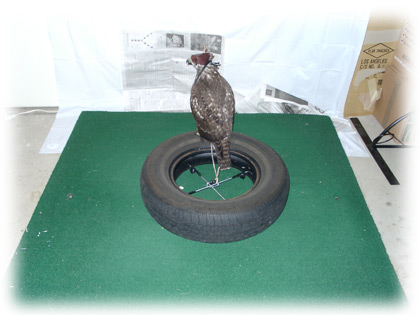 |
| A freshly trapped bird set up in a garage so that the light and environment may be completely controlled. The Astroturf is true stadium Astroturf and has an inch of rubber padding under it both insulating the bird from cold concrete and preventing her from bruising her feet or dulling her talons should she bate. The wall is protected from mutes with a simple shower curtail with newspapers over it allowing for muted papers to be removed daily. The bird cannot reach anything and is kept safe from the environment and other animals in a setup such as this. |
Mobile
Many traditional falconry cultures are highly mobile or nomadic. While many falconers in North America have a permanent residence and permanent structure for a mews, it is perhaps the most traditional practice to be without one. Some falconers spend months traveling and hunting with their birds, others outfit their mode of transportation for only day trips. Some use their vehicles as a mobile mews - and some are outfitted well enough that they could be permanent mews whether they use it that way or not.
Features
- Highly mobile
- Can be expensive to outfit
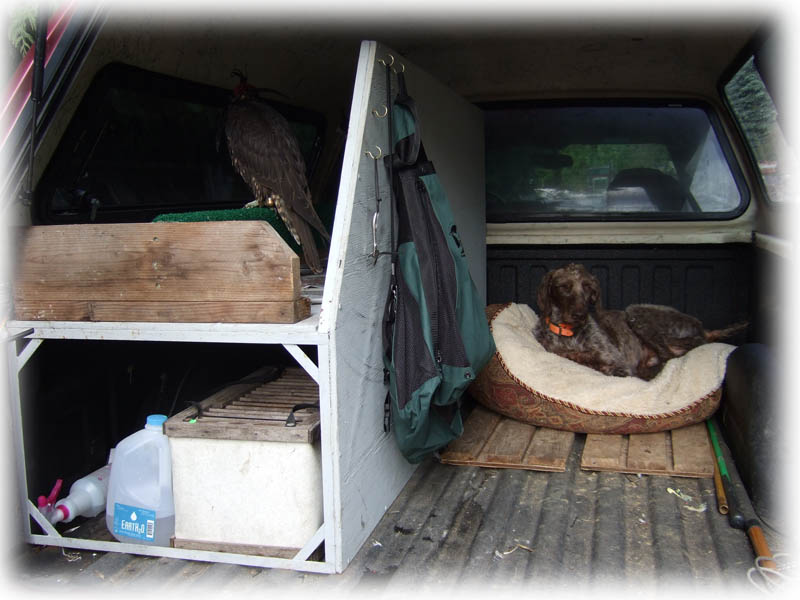 |
| This truck is outfitted comfortably enough for the dog and bird to have a space, and there's plenty of spots for storing equipment.
|
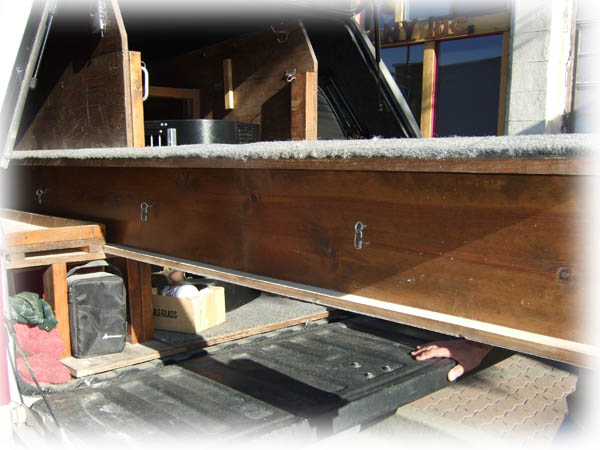 |
| This truck has a sliding perch that allows a whole row of falcons to be pulled out to be accessed. They can be accessed through the side window, or through this rolling perch. The eye screws allow each bird to be tethered. The vertical barrier and the horizontal under the birds catch mutes and keep them safe while they travel. Much equipment is stored underneath these birds. The row of birds is also under video surveillance that is displayed in the cab of the truck so the birds are constantly monitored. The whole back of the truck has several carbon monoxide detectors which will alert the driver if there is any trace of exhaust entering the enclosed bed. |
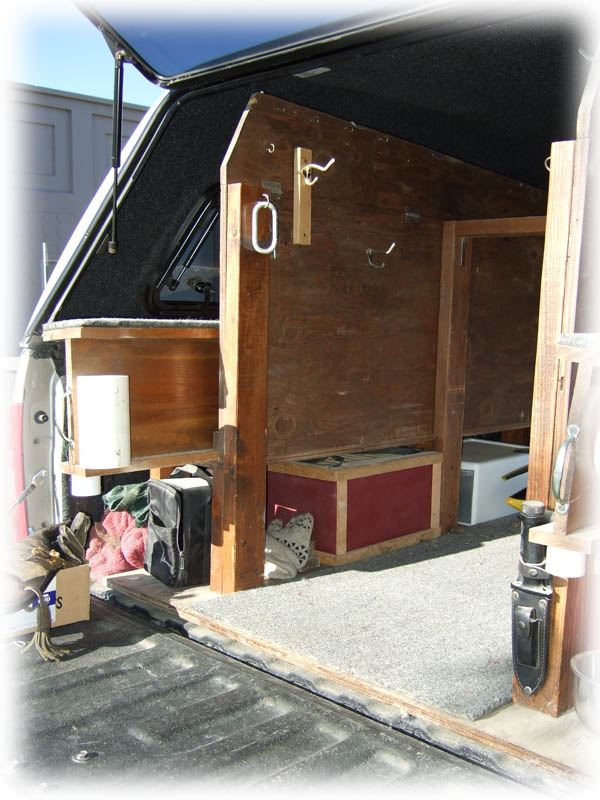 |
| Here the center aisle allows for more storage or for dogs. |
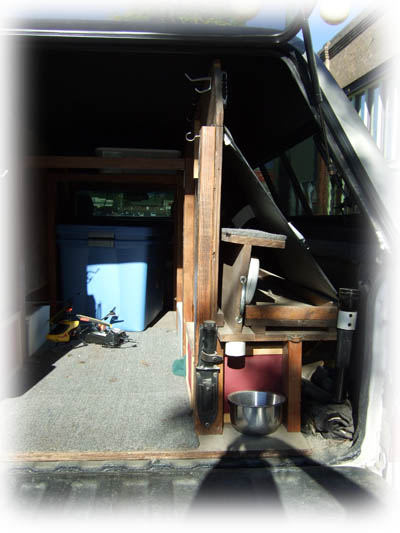 |
| The right side has a similar design to the left side allowing more birds to be perched and accessed, or storage for more equipment. Notice how well thought out the space is with specific locations and holders for even a flashlight. This allows everything to be secured and found again, through rough travel or even in the dark. |
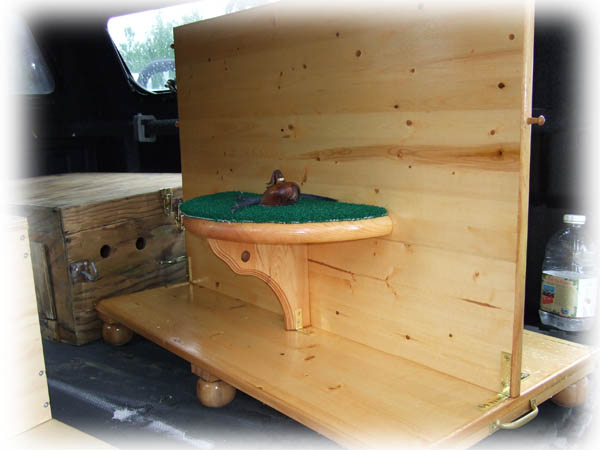 |
| Here a shelf perch has been set in a truck allowing for the arrangement to be placed in the house when needed or kept in the truck. |
Links
Various rehab aviaries http://thefeather.org/caging.htm
Incredible eagle aviary http://lonestarwildlife.org/eagle_flight.htm