 eashes
There are a variety of leash styles that have been successfully used in falconry. Most are very simple, but some are complex having several segments, sometimes with a segment of cord that is elastic or "gives" somewhat. Traditional leashes are made of leather strips. While these are natural and have a shock reducing amount of give, leather is a material that deteriorates - stretching, cracking, and will eventually break. A single leather strap will end up giving all at once as a single failure. This is why falconers will tie a bird up, then jerk the leash several times. This tests the integrity of that leash. Braided materials wear differently with each strand wearing through and breaking individually. Modern materials are thin and lightweight with high strength. In some braided equipment, the leash can be held by a single strand of the braid and still keep a strong bird securely tethered (although not recommended to be tested). This gives a falconer more opportunity to observe wear as it occurs and replace equipment before it fails.
Several makers have started incorporating bungee materials into their leashes. While this seems intuitively a good idea to dissipate the force of the bate, I have heard too many horror stories to be comfortable even recommending this equipment. While I will admit that this is anecdotal information and not scientific data, I am not willing to go and experiment with my bird's safety and have heard from excellent raptor vets to avoid this at all costs. The intent is to reduce the shock to the legs and therefore prevent a broken leg, however, there is good evidence that a leg break during bating is not from the stress applied by the static cord, but rather due more to the angle at which a bird bates and the degree to which it can get a foot hold. It is very likely that the bungee's recoil is at fault for snapping a bird's leg, but the recoil also pulls the bird back on her tail damaging her feathers. More often than not an elastic segment in a leash ends up catching on tail feathers wearing them abnormally.
Aside from security against bating, the leash needs to be the proper length. Too long of a leash (let's say 20') would allow a bird to get hung up on any number of obstacles, and would allow the bird to get up to a high speed only to hit the end of the leash and injure her legs or hips. Too short of a leash would not allow her to regain her feet after bating or will keep her hung up. As an example, with a bow perch set up on the ground, a leash could attach to the base on one side. The leash must be able to stretch over the furthest and highest point and still allow the bird to stand, yet without tangling. Because of this, the perch, leash, extenders, swivel, and whole management system needs to conform to the bird and her environment. As with dogs, horses, or children, there's always a way any bird can injure herself and that cannot be prevented 100%, however there are some better practices and some practices which tend not to work as well for many people. I have had perches that worked great for one bird, but for another bird with a slightly narrow leash the wrap on the sisal catches and interrupts the bird's movements. Close oversight and observation allows a falconer to notice this and take any corrections.
Equipment is not a place to scrimp. Pay for good, solid equipment and take good care of it. A well-made leash and proper swivel can last years with proper care. And good equipment is more likely to encourage safety and health.
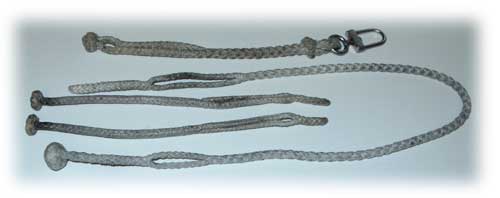 |
A well-made leash, jesses, and jess extender by Steve Layman after 3 years of daily use. This leash has been treated well, inspected daily when handling the bird, and kept in good shape. It likely has several more years in it. Here the swivel is shown with the opposite attachment for a standard British Falconer's Swivel (the U is attached to the leash) - this is because a jess extender is being used which makes the orientation of the swivel less relevant. |
Traditional Leash
This leash is very common and very simple. It can be made of leather, rope, parachute cord, or almost anything else. It is a single strap with a large knot or button at one end. This must be attached to the glove or perch using a Falconer's Knot, or other safe knot such as a Halter Knot. One advantage of this leash is that it can be tied at any length to accommodate many different situations and perches. One minor advantage of the knot is that if a bird gets loose trailing this leash, there's a good chance that the leash will fall out of the swivel easily or that the bird will pull it out. This should be such a rare occurrence as to make this a negligible consideration when choosing a leash. Instead of a end knot or button, some have substituted a leather flap or a metal washer, or even a metal washer covered in leather. This works great on some, but with a very playful bird like a Gyrfalcon who tend to bite anything different, she could chip the tip of her beak.
How to tie a Falconer's Knot
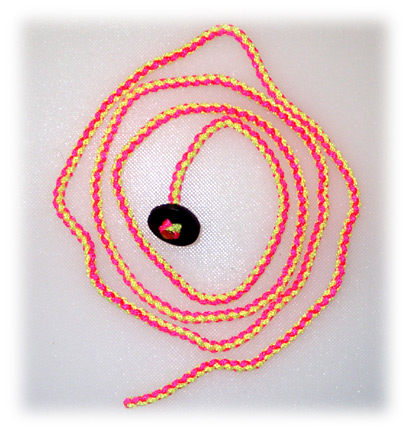 |
A well-made traditional leash made by Al Ingram. The fluorescent colors may seem untraditional, but they serve a purpose as it makes the leash easier to spot if dropped in the field. |
This particular style of leash depends on the button to hold on to the swivel. The leash slides through the swivel and the button stops it. Because of this single point of failure, the button must be examined regularly to ensure its integrity and check it for wear.
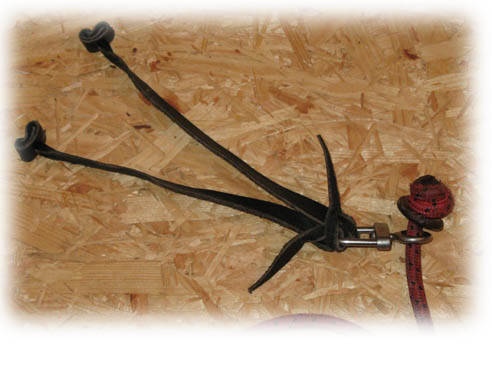
Image courtesy of Scottish falconer Johann Hanekom. |
Fox Leash
This leash was devised by Nick Fox and is sometimes called the Fox Loop Leash. It is marked by having a loop at one end instead of a button or knot. The advantage to this is that the loop can be affixed around the swivel more securely than depending on a button to be larger than the opening in the swivel. This also must be attached to the glove or perch using a Falconer's Knot, or other safe knot such as a Halter Knot. The advantage to this leash is that the loop traps the swivel in one place so that the swivel doesn't travel along the leash. It can also be tied at a variety of lengths. Falconers can adjust the length of a loop leash by looping the leash through the tether point multiple times before attaching.
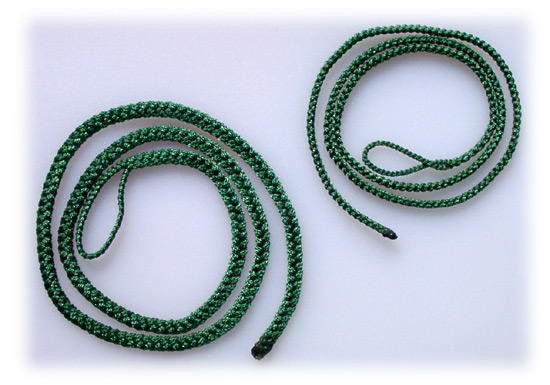 |
Two well-made Fox Leashes made by Josh Wennergren. The leash on the left is a flat braid and the leash on the right is a round braid. |
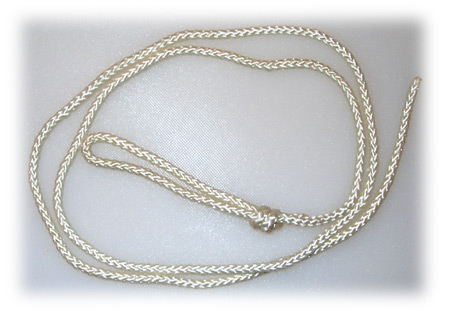 |
A simply made Fox leash. |
Layman Leash
This leash was designed by Steve Layman and is really an entire system. It is a braided Spectra setup marked by having two loops and one knot or button. There is a loop up near the button that the button will be slid through to hold the swivel end. The other loop is at the opposite end and will go around the perch. One advantage of this leash is that it is always tied at the same length and gives no ability to slip. When it is attached, to a perch or a glove, it will not come undone and allow a bird to escape trailing a leash. It rarely tangles and is almost impossible to set up incorrectly. Some may see it as an advantage that the leash is one length only. If the leash is made to the proper length for the bird and her perch, then it is always guaranteed to be the perfect length. However, if many different configurations of perches are used with a variety of leash length needed, this can be a disadvantage. Falconers can adjust the length of a loop leash by looping the leash through the tether point multiple times before attaching.
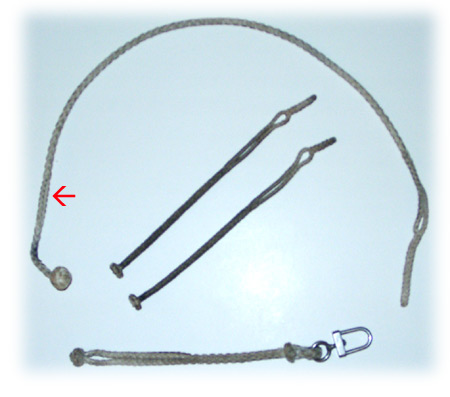 |
A Layman Leash System. The arrow is pointing to the loop nearest the button. The braided piece at the bottom attached to the swivel is a jess extender. Here the swivel is shown with the opposite attachment for a standard British Falconer's Swivel (the U is attached to the leash) - this is because a jess extender is being used which makes the orientation of the swivel less relevant. |
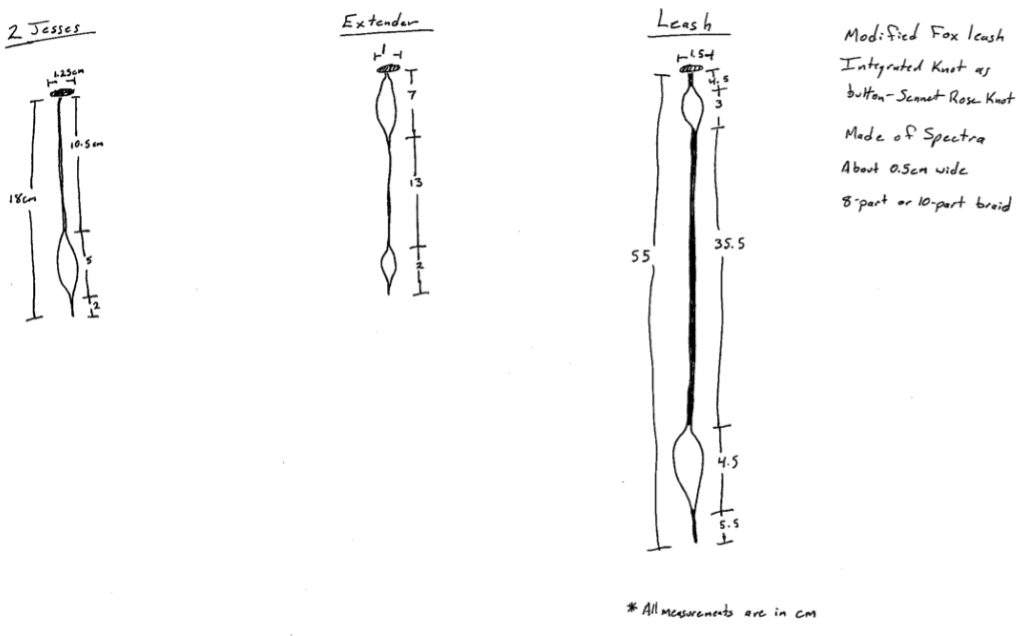 |
My Layman Leash System measured in cm. This works perfectly with my Meng perch that is 20" high. |
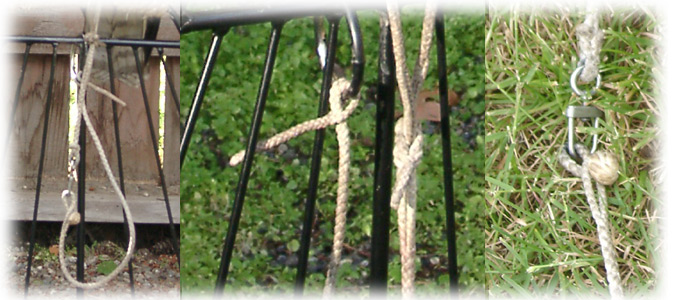 |
Showing the Layman Leash System in use and how it is attached. |
Integrated Leash
This braided Dacron leash is a modification of the Layman Leash with the addition of an integrated swivel. The advantage of this leash is the light weight of the swivel. Because there is not a significant pivot point around the swivel, the swivel tends not to get trapped and stop functioning. This is particularly good for highly mobile birds, birds which move a lot on their perches, or the smaller birds. The Spro Heavy Duty Swivel is measured to be 1.5 times stronger than the typical barrel swivel.
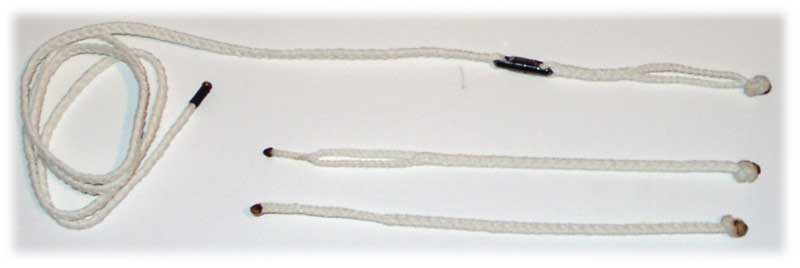 |
An integrated leash. The swivel attaches the leash to the jess extender.
Leash system designed and crafted by Richard Jones. |
Leash
This leash is quite small, but is not adjustable. It locks the bird to the glove. In this case it is very light weight and appropriate to the size of being being managed. It features a small swivel on each end.
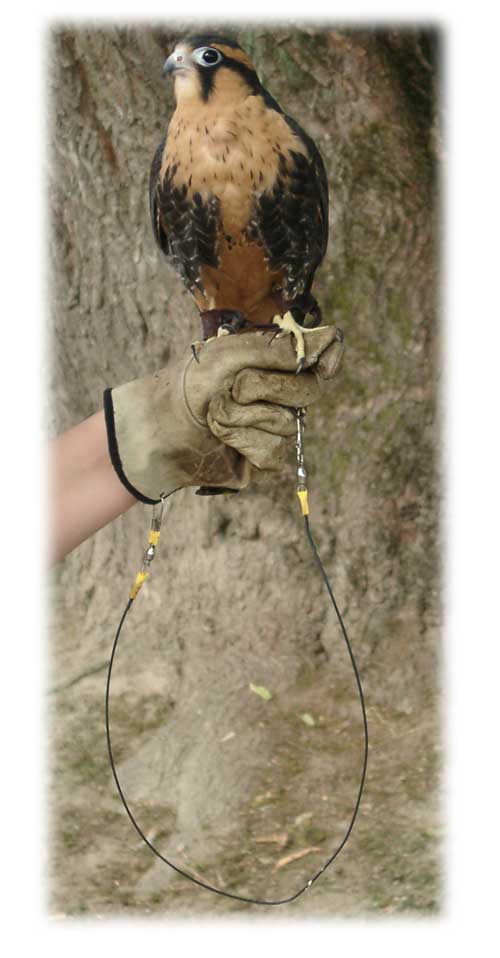 |
An Aplomado with a lightweight leash attached to the glove. |
One of the safest ways to pick up a bird is to first get hold of the leash in the gloved hand above the swivel and connection. This allows control of the bird should she bate. Then attaching a glove leash. Although these are not absolutely dependable, they are like extra insurance. Then the leash can be untied or disconnected from the perch. At this point the leash should be tied to the falconer's glove through a D-ring attachment if it is available. Some like to just hold the leash or hold the leash in the opposite hand. This can be problematic if the falconer is walking and trips, if the leash slips, of if he needs to use his other hand for something. The glove does not offer the best dexterity and until a falconer is familiar with the feel of the leash and the behavior of the bird, this method will prove very secure. The combination of the glove leash attached during the time when the bird's leash is being disconnected and attached to the glove may seem small, but many birds have been lost in simple handling.
Similarly, when putting a bird back on her perch, it is useful to have the glove leash attached and a hold of the leash above the swivel in your gloved hand before disconnecting the leash from the glove. After attaching the leash to the perch, tug it a few times to test the connection and security, then disconnect the glove leash, set the bird on the perch and verify she is secure and comfortable.
 |
A Red-Tail Hawk on the fist with a glove leash attached as well as the Layman leash connected securely to the glove. |