 merican Kestrel
This bird is native to North America with at least 15 subspecies running the length of the Americas and near world-wide distribution of the species. It is not a traditional bird in European or Middle Eastern falconry as it does not exist in the wild in Europe, but it has been very successfully used for falconry worldwide since North American falconry developed. As the smallest American falcon, the size makes it unintimidating to a novice, however that is also a hidden danger as their metabolism is so high that in order to keep them in peak condition, precise measurements must be made of their weight and food intake.
While this is often called the American Sparrowhawk, or the Sparrowhawk, this bird is not to be confused with the Eurasian Kestrel or the Eurasian Sparrowhawk, which is an accipiter.
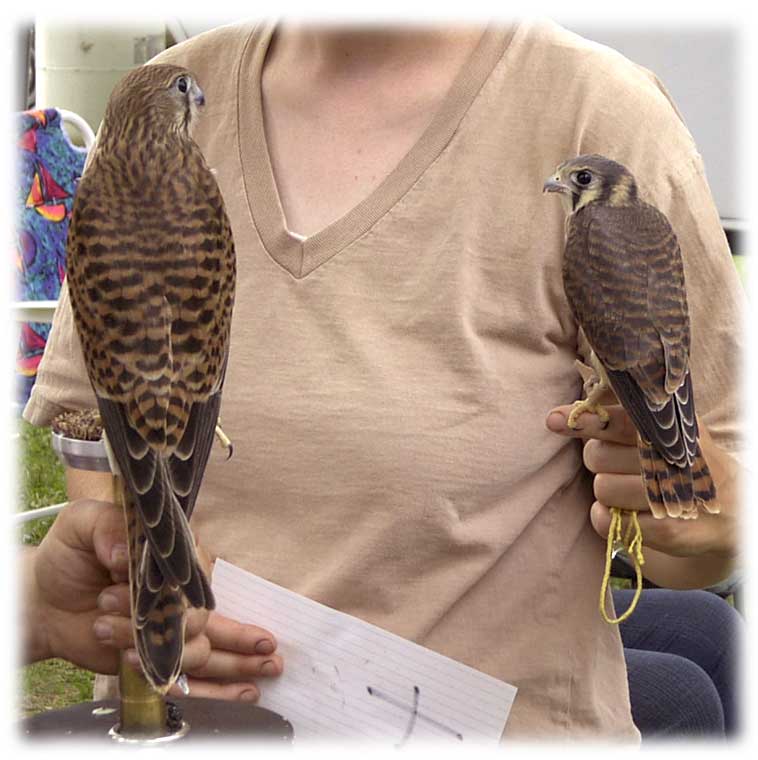 |
A European Kestrel on the left and an American Kestrel on the right, both female.
Photo courtesy of Will Lake. Eurasian Kestrel owned and flown by Will Lake. |
Plumage
The immature plumage of the Kestrel is not long lasted as the American Kestrel goes through a moult within 6 months of hatching and is not distinctively differentiated from their first-year plumage. Partly because of this, the haggard Kestrel is an acceptable bird for an apprentice to trap. The male and female are very differently colored. The female is a duller brown and blue-gray color while the male has more striking rust and stronger blue-gray colors.
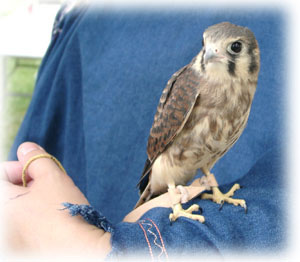 |
A lovely example of an immature female Kestrel - falconer's hand shown for comparison of size
Kestrel owned and flown by Jamie Perlman. |
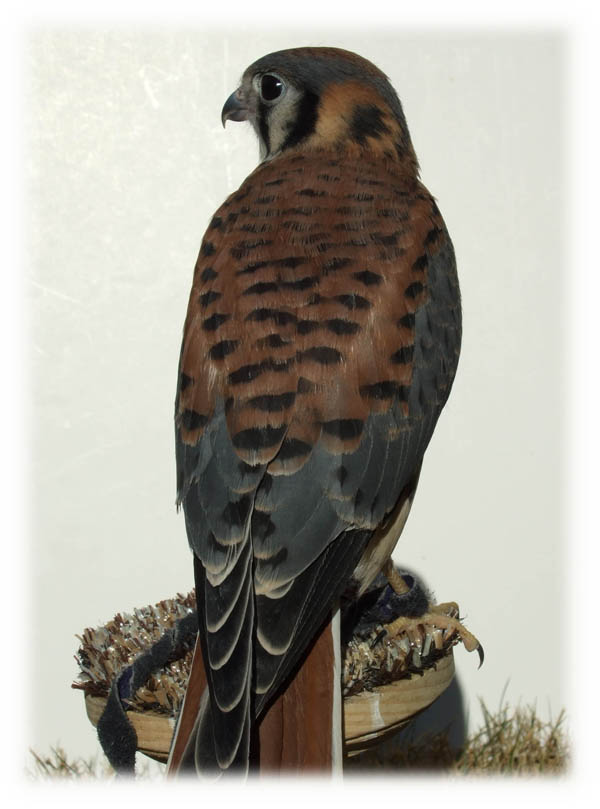 |
A lovely example of an immature male Kestrel |
Hunting
Typical quarry caught with the Kestrel are mice, house sparrows, starlings, English sparrows, and insects such as dragonflies and grasshoppers. These birds subsist on small mice and insects in the wild, nearly completely on grasshoppers in the late summer. Commonly passed over as a hunting companion for not having the flashy style of some other birds, these birds can actually be hunted in a backyard and have been known to be flown by handicapped falconers who are able to manage the hunting style and quarry that this falcon takes.
This small raptor has a unique ability to hover in mid-flight.
In the summer when this bird is catching grasshoppers, other insects, and mice, it hunts in a typical buteonine style. During the winter months when this bird is hunting other small birds, it hunts in a falconine fashion.
Diet
This bird does well on a diet of wild caught English sparrows, wild caught small rodents, and even frozen purchased mice. Grasshoppers make an excellent addition to their diet. Some falconers have noted that whey they fed a Kestrel on an all-mammal diet the birds lost color in their cere and legs, and adding birds back into the Kestrel's diet caused the color to return.
Trivia
The Kestrel is also referred to as the American Kestrel, American Sparrowhawk, Eastern Sparrow Hawk, or Sparrow Hawk (a misnomer as this is actually a falcon). Also referred to as a "windhover" due to their ability to hover in flight, and due to their call of "killy killy killy" they are sometimes called the killy hawk. This becomes very confusing when discussing the Eurasian Sparrowhawk or the European Kestrel. These are wide-spread and estimated to have a breeding population of 2.4 million in the US alone.
Wild Kestrels will often take up residence in a man-made bird house. They will also nest in cavities such as old nesting holes of a flicker or large woodpecker.
One characteristic of the Kestrel is the tail pumping actions, head bobbing, and hovering flight style it performs.
This bird will most usually have a hunting weight around 100 g. Males may have a hunting weight range of 94 g to 126 g, and females may have a range of 115 g to 160 g depending on the subspecies and particular individual. For its size, this bird has the most powerful foot of any of the birds used in falconry.
Kestrels are not known for being highly motivated to hunt, unlike many other species such as Merlins or Goshawks. These birds need to know they have a distinct advantage over their intended prey in order to give chase.
At a distance it can be difficult to tell a Kestrel from a Merlin. One trait to note is when they are perched. A Kestrel will tend to stand on telephone wires whereas a Merlin will tend to perch on the telephone poles or the transistor.
Links
Kestrel Falconry http://KestrelFalconry.com
Lure Flying a Kestrel https://www.youtube.com/watch?v=uALsdmbnCMg
Lure Flying a Kestrel https://www.youtube.com/watch?v=o9tUEJa3ISU
Kestrel Day 1 https://www.youtube.com/watch?v=I1SinFOg4iE
Kestrel Day 2 https://www.youtube.com/watch?v=chjfH4OjcEc
Kestrel Day 3 https://www.youtube.com/watch?v=X_169DpKhzg
Kestrel and lure https://www.youtube.com/user/kestrelhawke
https://groups.yahoo.com/neo/groups/kestrelfans/info
http://kestreling.com/
http://birdsbybent.com/ch1-10/kestrel.html